

Claudia Laurent
Golf writer, Golf Handicapp · 12 May 2026
The short answer
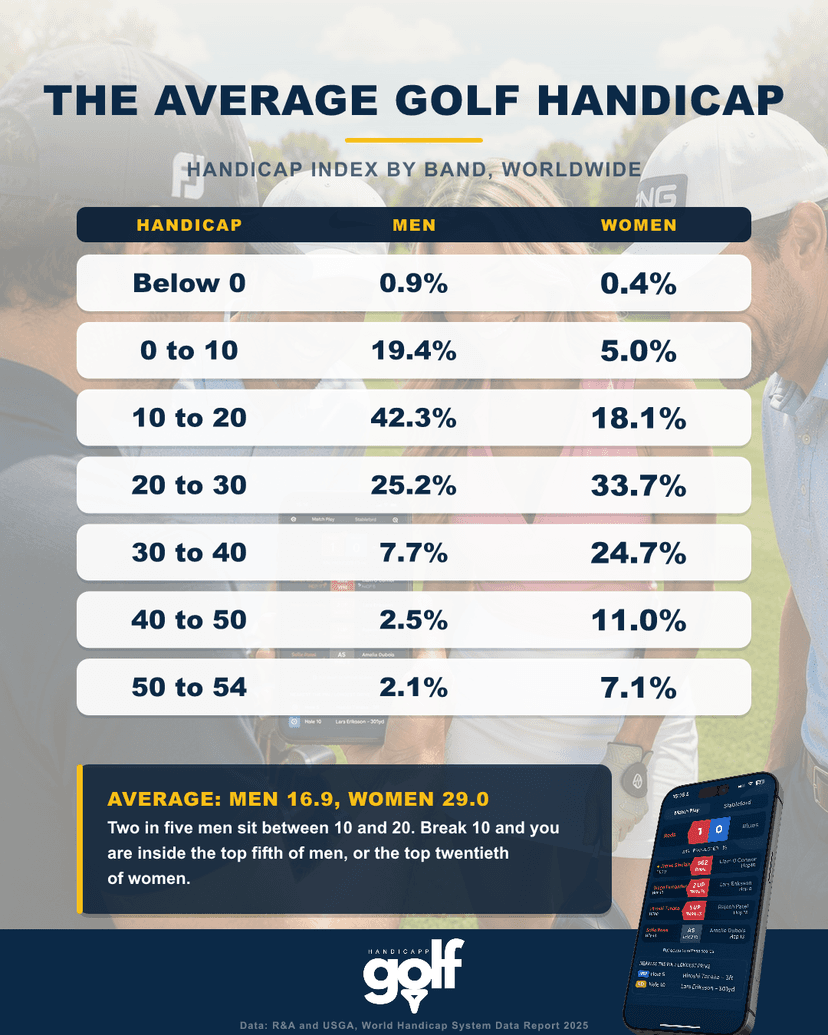
A good golf handicap is relative to where you are. Single figures, under 10, is genuinely good and reached by a minority of golfers. Scratch, a Handicap Index of 0.0, is elite. Worldwide the average man is 16.9 and the average woman 29.0, so for most players a good handicap simply means lower than last season.
It is the question every golfer asks once they have a number to their name. The honest answer is that “good” depends on who is asking. A 12 is brilliant for someone who picked up the game last year and frustrating for a player who was off 6 two summers ago. So rather than give you one number, this post sets out the bands most golfers fall into, what each one means in real scores, and how to move yourself down a band.
What a handicap actually measures
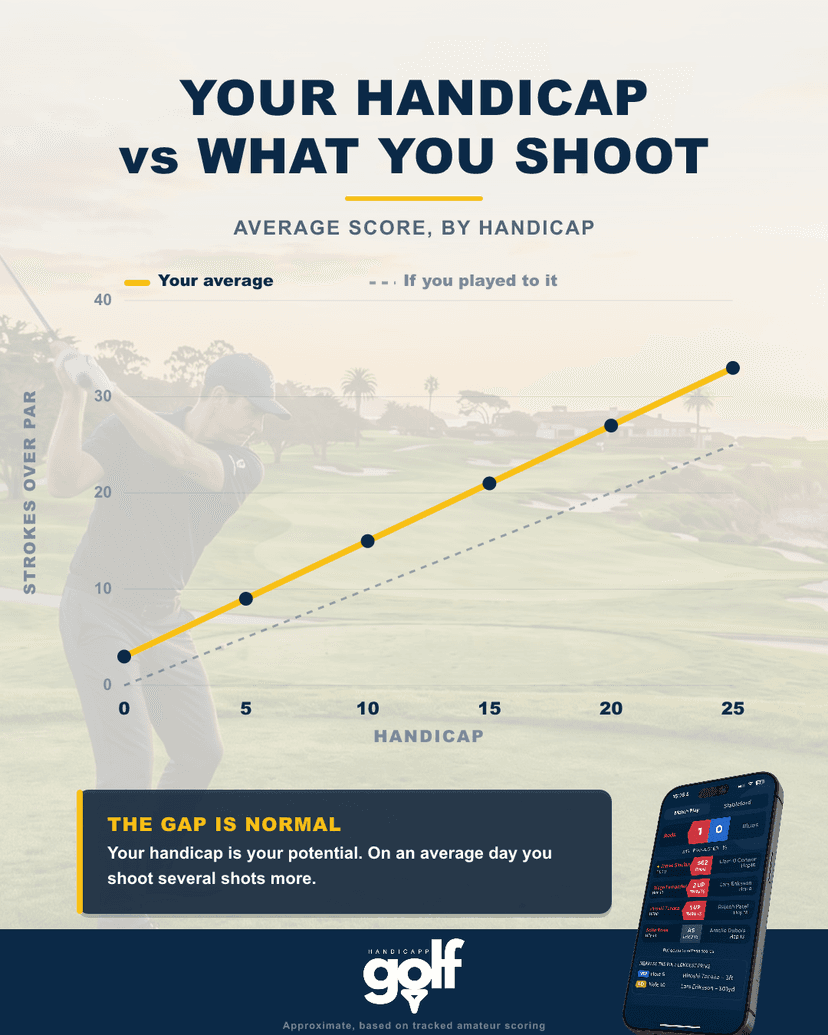
Your Handicap Index is not your average score. It is a measure of your demonstrated potential, built from the best 8 of your most recent 20 score differentials. Because it leans on your better rounds, your index reflects what you are capable of on a good day, not what you shoot on a scrappy one. That is worth remembering before you judge yourself harshly: the system already knows you do not play your best every time. If you want the full mechanism, our guide to how the WHS handicap is calculated walks through it step by step.
The handicap bands, and what each one shoots
Here is the rough map. Scores assume a standard par 72 of moderate difficulty. A harder course inflates them, which is exactly why the handicap system adjusts for course rating and slope in the first place.
| Band | Index | What it looks like |
|---|---|---|
| Plus / scratch | +x to 0 | Level par or better. A small, elite group. |
| Low single figures | 1 to 5 | Mid 70s to low 80s. Strong club golfer. |
| Single figures | 6 to 9 | Low to mid 80s. The classic mark of a good golfer. |
| Low handicap | 10 to 14 | Mid 80s to low 90s. Better than most who hold a handicap. |
| Mid handicap | 15 to 21 | Around 90 to high 90s. Where a large share of golfers sit. |
| High handicap | 22+ | High 90s and above. Plenty of room to improve, and that is the fun bit. |
So what is the average?
The R&A and USGA World Handicap System Data Report 2025 puts the average Handicap Index at 16.9 for men and 29.0 for women, across 6.5 million golfers in 57 countries. Figures taken from the American GHIN system alone come out lower, nearer 14 for men, because they describe one country rather than the whole game. The spread either way is wide. The practical takeaway is that breaking into single figures puts you well ahead of most people who hold an official handicap, and reaching the low teens already means you are playing a solid, consistent game. We break the full distribution down band by band in what is the average golf handicap.
Why the same round is worth different numbers
A good handicap is not just about your score, it is about the course you shot it on. Posting 88 round a gentle layout is very different from posting 88 round a brute, and the handicap system captures that through course rating and slope. Take The Heron Country Club off the white tees, rated 73.4 with a slope of 131, par 72. A golfer off a Handicap Index of 9.0 gets a Course Handicap there of 9.0 × (131 / 113) + (73.4 − 72) = 12 strokes, so a gross 84 plays to roughly a net 72, dead on the rating. The same player off the same index would get fewer strokes on an easier track. That is the whole point of course rating and slope, and you can see your own number for any course with our WHS handicap calculator.
Track every round and watch your index move
Free to use, with no subscription and no club membership needed.
How to actually get to a better handicap
The fastest gains for most golfers are not on the range, they are in avoiding the big numbers. Because your index is built from your best 8 rounds, one clean card with no blow-up holes does more for your number than a flashy front nine wrecked by a triple bogey. Course management, a reliable tee shot you can repeat, and a tidy short game quietly shave more strokes than chasing distance. Our guide on how to lower your golf handicap goes deep on this, and the single most useful habit is the simplest: post every qualifying round, good or bad, so your index is honest and you can see what is working.
Do not have a handicap yet?
Then your first good handicap is just having one at all. You need 54 holes of scores to be issued a Handicap Index, and you no longer have to join a club to get an official one. We cover the route in how many rounds you need for a handicap and the brand new player's version in golf handicap for beginners. Once you are tracking, the number takes care of itself.
Common questions
What is a good golf handicap for a beginner?+
When you first get a handicap it will often sit in the high 20s or higher, and that is completely normal. For a beginner, a good handicap is simply one that is trending down. Getting from the high 20s into the low 20s in your first full season is solid progress.
Is a 10 handicap good?+
Yes. A handicap of 10 means you are close to single figures and you typically shoot in the low to mid 80s on a standard par 72. That is better than the large majority of golfers who hold an official handicap.
What does scratch mean?+
A scratch golfer has a Handicap Index of 0.0, which means they are expected to play to the course rating. It is a small, highly skilled group. Plus handicaps, written with a plus sign, are better than scratch.
What is the average golf handicap?+
Worldwide it is 16.9 for men and 29.0 for women, from the R&A and USGA World Handicap System Data Report 2025. Figures drawn from the American GHIN system alone come out lower, nearer 14 for men, because they cover one country rather than 57.
Keep reading

About the author
Claudia Laurent · Golf writer, Golf Handicapp
Claudia writes about the World Handicap System, golf scoring and getting more from every round for Golf Handicapp. She is a mid-handicap golfer who logs every card, the good ones and the ones she would rather forget.
Last updated 12 May 2026.