The short answer
Course Rating is the score a scratch golfer is expected to shoot from a set of tees, written to one decimal place. Slope Rating is how much harder the course plays for an average (bogey) golfer than for that scratch golfer, on a scale from 55 to 155, where 113 is standard. Course Rating sets the bar; Slope scales how much each round counts.
Course Rating in detail
Course Rating answers a single question: if a scratch golfer (a player off zero) walked these tees on a normal day, what would they shoot? It is expressed to one decimal, like 71.2, which is why it is more precise than par.
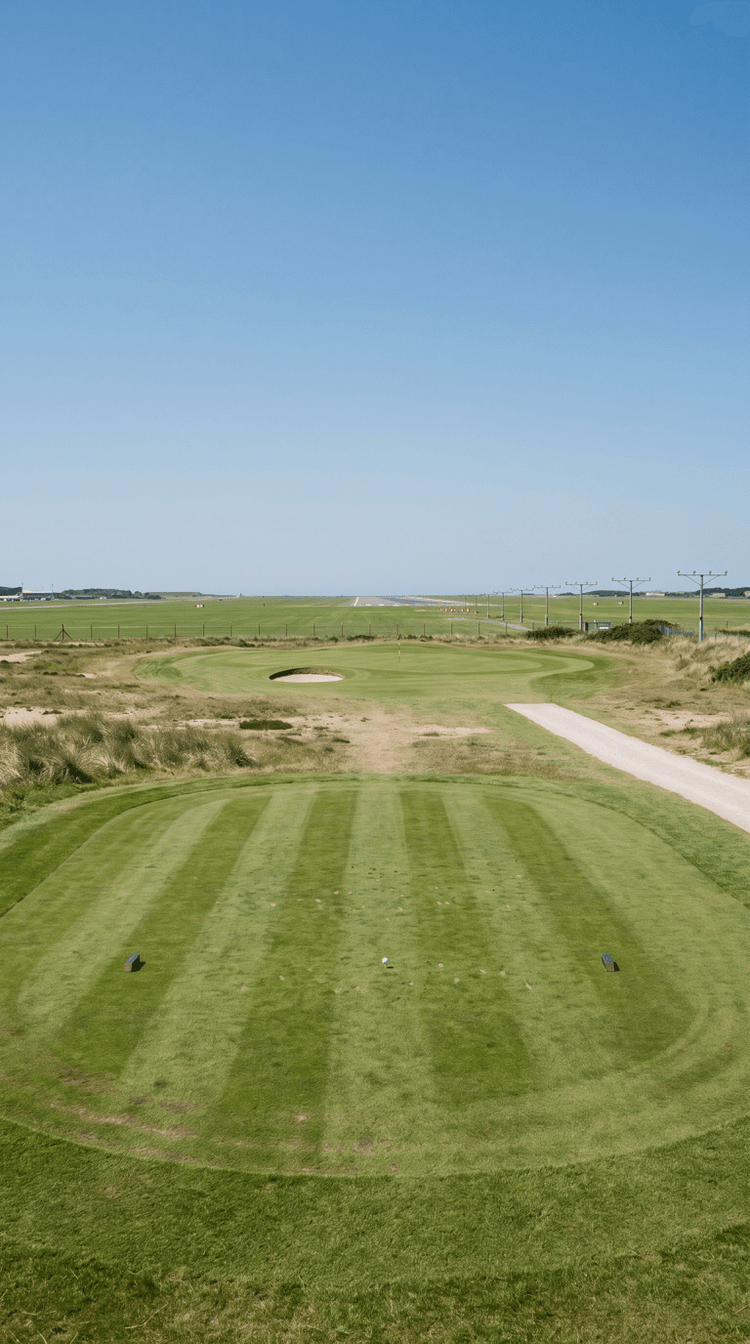
Crucially, Course Rating is usually not the same as par. Par is a round number set by the club; Course Rating is a measurement of real difficulty. A short, open course can carry a rating below its par. A long or heavily defended one rates above par. For example, Aldeburgh off the yellow tees is a par 68 but rated 71.0, so it plays roughly three shots harder than its par would suggest. By contrast, Oakland Park off the white tees is a par 67 rated 66.3, a touch easier than its par.
Slope Rating in detail
Course Rating describes the test for a scratch golfer, but most of us are not scratch. Slope Rating captures how much more a course punishes a bogey golfer than it punishes a scratch one. Forced carries, deep rough, water and small greens hurt the average player far more than the expert, and a high slope reflects that.
The scale runs from 55 to 155, and 113 is the slope of a course of standard difficulty. That number is not arbitrary: it is the reference point the whole system is built around. A slope well above 113 is a course where a bad day can really run away from you; a slope below 113 is more forgiving.
Why both numbers matter for your handicap
Both feed directly into the score differential, the per-round number behind your handicap index:
(113 / Slope Rating) × (Adjusted Gross Score − Course Rating)
Course Rating is subtracted from your score, so it sets the baseline. Slope then scales the result against that standard 113. The effect is real. Take a round played exactly 18 strokes over the Course Rating. At a standard slope of 113 the differential is 18.0. At a brutal slope of 140 it is (113 / 140) × 18 = 14.5, because that score was harder to achieve. At a gentle slope of 100 the same round gives (113 / 100) × 18 = 20.3. Same effort, different reward, because the courses asked different questions.
Want your differential without the arithmetic?
Pick your course and tees, enter your score, done.
You can try exactly that with our free WHS calculator, which fills in the real Course Rating and Slope for whichever tees you select.
How are these numbers set?
Course and Slope ratings are not chosen by the club. They are measured by trained rating teams working under the national body, for example England Golf, the R&A or the USGA, using the World Handicap System rating method. The team measures effective playing length and a long list of obstacle factors (rough, bunkering, water, green difficulty, and more) for both a scratch and a bogey golfer. Courses are re-rated periodically and after major changes, which is why an old scorecard can show different numbers from today.
Where to find Course Rating and Slope for any course
They are printed on the scorecard, listed on most club websites, and for more than 24,000 courses they are right here. Search our course directory and open any course to see the rating and slope for every tee, or drop a course straight into the calculator and let it pull the numbers for you.