The short answer
Each round produces a score differential, a measure of how you played relative to the course. Your Handicap Index is the average of the best 8 of your most recent 20 differentials. A couple of caps stop it rising too fast, and a small daily conditions adjustment keeps things fair. That is the entire system.
The score differential formula
Everything starts with one round and one equation. The score differential is how the system turns your score into something comparable across every course in the world:
(113 / Slope Rating) × (Adjusted Gross Score − Course Rating − PCC)
Take a real example. Jamie shoots a gross 84 at The Heron Country Club off the white tees, which are rated 73.4 with a slope of 131. Assume no blow-up holes and a PCC of zero. The differential is (113 / 131) × (84 − 73.4) = 0.863 × 10.6 = 9.1. One round, one differential. Do that twenty times and you have the raw material for a handicap. If the terms slope and course rating are new to you, the Course Rating vs Slope guide covers them.
Adjusted Gross Score and Net Double Bogey
Notice the formula says Adjusted Gross Score, not your raw total. This is the part most explainers skip, and it matters. Before your score counts, every hole is capped at a Net Double Bogey: par, plus two shots, plus any handicap strokes you receive on that hole.
Say a 12 handicapper makes a nightmare 9 on a par 3 with stroke index 5. With a course handicap around 12 they receive one stroke on that hole, so their Net Double Bogey is 3 + 2 + 1 = 6. The 9 is written down on the card, but only a 6 goes into the handicap calculation. This single rule, which replaced the old Equitable Stroke Control, stops one wipe on the card from wrecking an otherwise representative round. Our quick calculator assumes you did not need any of these caps, so it matches your posted differential on a clean round.
The 8 of 20
Your Handicap Index is not your latest differential and it is not the average of all of them. It is the average of the lowest 8 of your most recent 20. The system deliberately works from your better rounds, because a handicap is meant to represent your potential, what you can do on a good day, not your scrappy average.
You do not need 20 rounds to start. From your third score onward you get an index, calculated from a smaller sample with a small adjustment, scaling up as your record fills in:
| Rounds posted | Differentials used | Adjustment |
|---|---|---|
| 3 | Lowest 1 | minus 2.0 |
| 4 | Lowest 1 | minus 1.0 |
| 5 | Lowest 1 | 0 |
| 6 | Lowest 2 | minus 1.0 |
| 7 to 8 | Lowest 2 | 0 |
| 9 to 11 | Lowest 3 | 0 |
| 12 to 14 | Lowest 4 | 0 |
| 15 to 16 | Lowest 5 | 0 |
| 17 to 18 | Lowest 6 | 0 |
| 19 | Lowest 7 | 0 |
| 20 | Lowest 8 | 0 |
Once you reach 20 rounds it settles into the familiar best 8 of 20, and each new round pushes the oldest out, so your index keeps pace with your current form.
Let the app keep your best 8 of 20 up to date
Logging rounds and your handicap are free, always.
Low and high handicap adjustments
Two safeguards stop your index lurching around. The soft cap watches your lowest index from the last 365 days; once your calculated index rises more than 3.0 strokes above that low point, the part beyond 3.0 is halved, so a run of poor rounds raises your handicap more gently. The hard cap then sets an absolute ceiling: your index cannot climb more than 5.0 strokes above that same low point. Both only restrain increases. There is no cap on improvement, so you can come down as fast as your golf allows.
Playing handicap vs handicap index
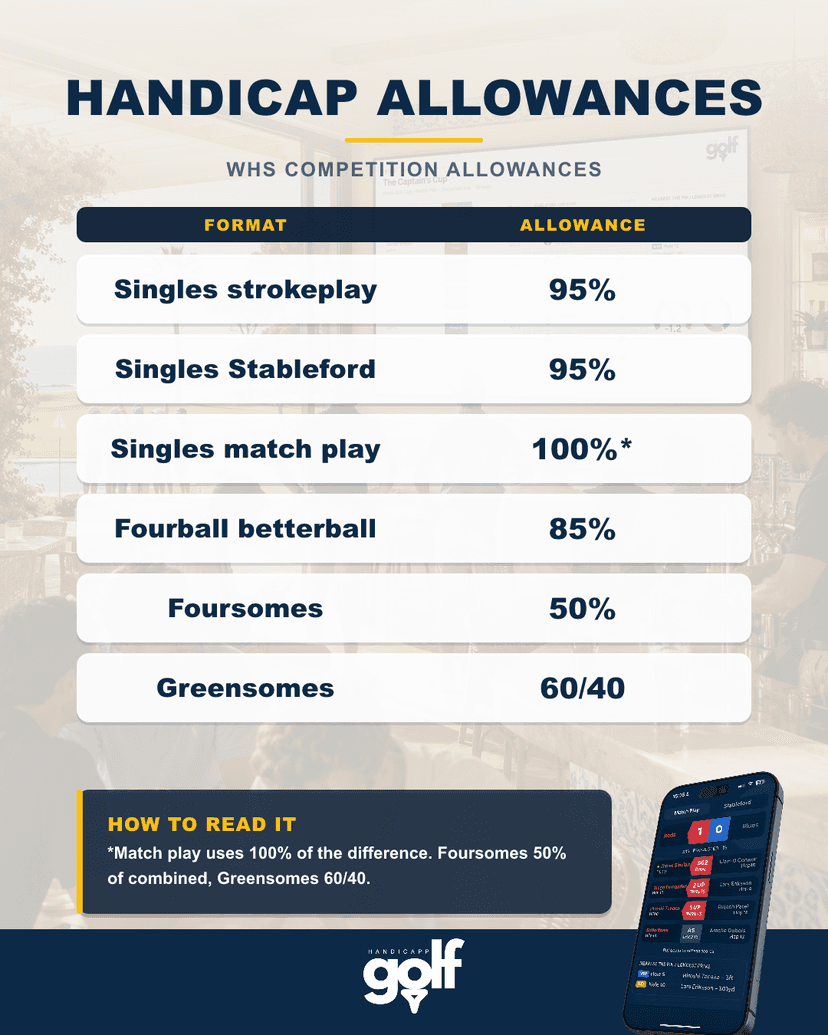
Your Handicap Index is portable, one number that travels with you. It is not, however, the number of shots you get on the day. That is your Course Handicap (the index adjusted for the tees you are playing) and then your Playing Handicap (adjusted again for the format and any allowance). The index is the foundation; the on-the-day numbers are built from it.
Playing Conditions Calculation (PCC)
Finally, the small print. After play, the system reviews how the whole field scored at a course on a given day. If conditions made scoring abnormally hard or easy, the PCC nudges every differential at that course by a set amount, anywhere from minus 1 to plus 3. On the vast majority of days it is zero, and you never calculate it yourself. For everyday understanding you can safely ignore it; it simply keeps a wild-weather round from being treated like a calm one.