The short answer
Your Handicap Index is your portable number. Convert it for the tees you play and you get your Course Handicap (whole strokes for that course). Apply the format's allowance and you get your Playing Handicap, the strokes you actually receive that day. Index travels; the other two are worked out per round.
1. Handicap Index
This is the headline number, the average of your best 8 of 20 differentials. It is deliberately course-independent so it means the same thing wherever you play. It is also the only one of the three that is not, by itself, the number of shots you get. For how it is built, see how the WHS handicap is calculated.
2. Course Handicap
A scratch test at one course is a different test at another, so your index is converted for the specific tees you are playing:
Course Handicap = Index × (Slope / 113) + (Course Rating − Par)
The slope term scales your index to how punishing those tees are; the course-rating-minus-par term adjusts for tees that play harder or easier than their par. The result is rounded to a whole number of strokes.
3. Playing Handicap
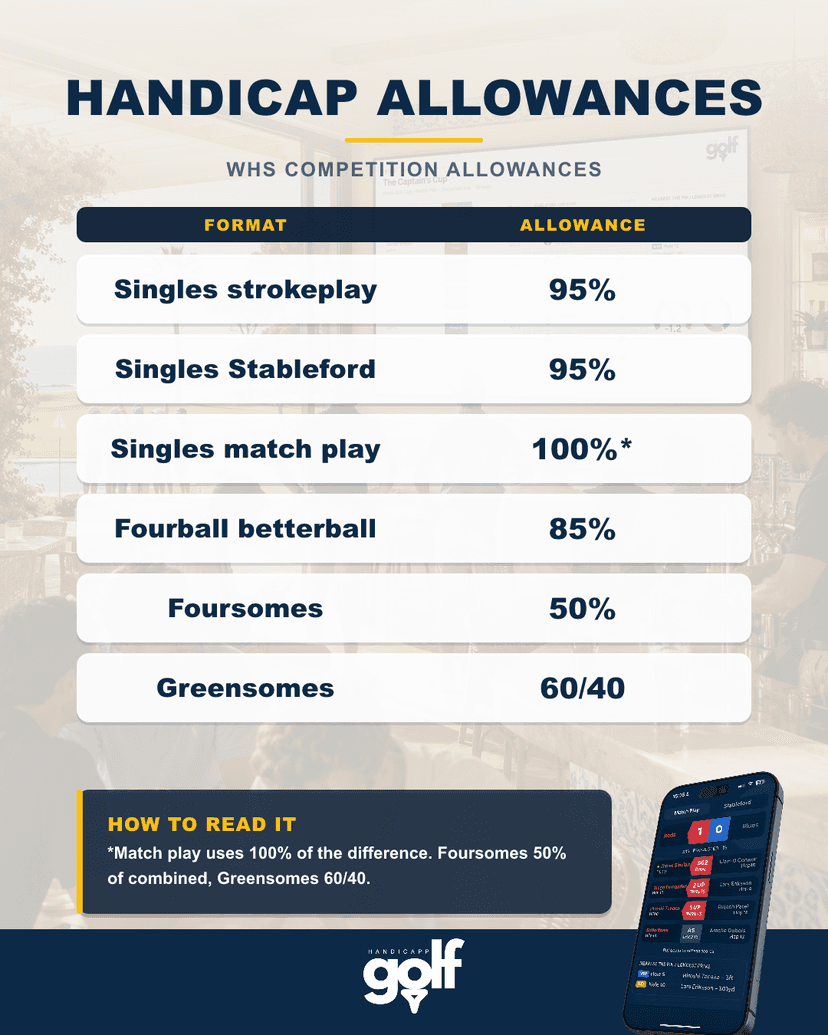
Finally, the format gets a say. Many competitions apply a handicap allowance, a percentage that keeps things fair across a field, for example 95 percent in individual stroke play or different figures in fourballs and Stableford. Your Playing Handicap is your Course Handicap after that allowance, and it is the number of strokes you actually receive.
Playing Handicap = Course Handicap × Handicap Allowance
Your course handicap, worked out for every tee
No tables, no mental arithmetic on the first tee.
A full worked example
Say your Handicap Index is 12.0 and you are playing the white tees at The Heron Country Club, which are rated 73.4 with a slope of 131, par 72.
Course Handicap = 12.0 × (131 / 113) + (73.4 − 72) = 12.0 × 1.159 + 1.4 = 13.9 + 1.4 = 15.3, which rounds to 15. So before any allowance you receive 15 strokes at those tees, more than your index of 12, because the course is harder than standard and rates above its par.
Now apply a 95 percent individual stroke-play allowance: Playing Handicap = 15 × 0.95 = 14.25, which rounds to 14. That 14 is what goes on the card. Same golfer, same index, and yet the strokes received changed at every step, which is exactly why the three numbers are worth telling apart.