
Claudia Laurent
Golf writer, Golf Handicapp · 12 July 2026
The short answer
Three-putts feel round-ruining, but they happen less than you think. A 5 handicap three-putts about once a round, a 15 handicap around twice, a 25 handicap two or three times. The real culprit is distance control on the first putt, not the short one you miss, so get the lag putt to the hole and most of them disappear.
Nothing sours a good hole like walking off with a three-putt, and most golfers are convinced they do it constantly. The tracked data is kinder than the memory. Here is how often golfers really three-putt, broken down by handicap, and the one thing that fixes more of them than any amount of work on your stroke. It is worth reading before you blame your putter again.
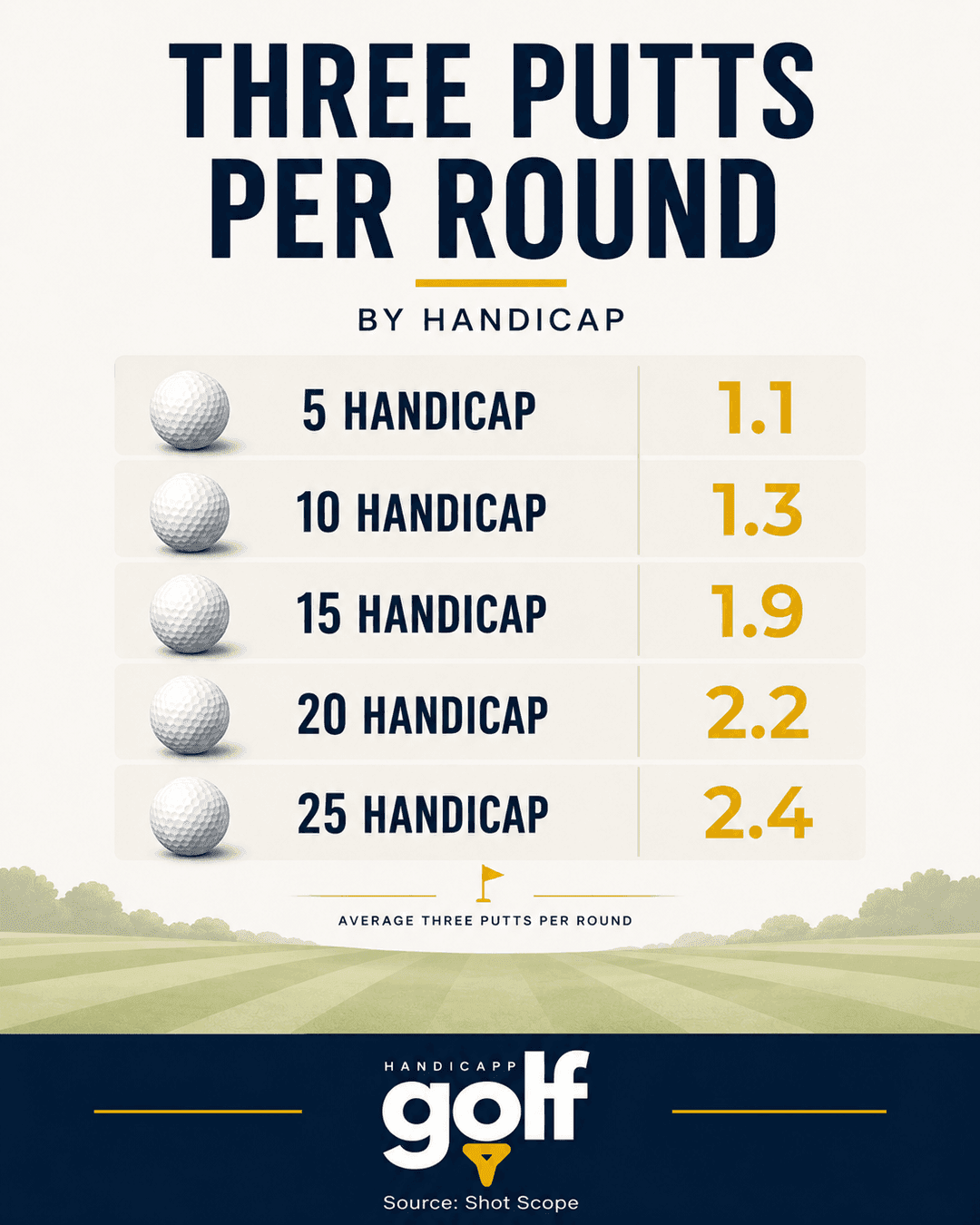
Three-putts per round, by handicap
Read it as the average number of three-putts in an 18-hole round. The climb from a 5 to a 25 handicap is real but gentler than most golfers would guess.
| Handicap | Three-putts per round |
|---|---|
| 5 handicap | 1.1 |
| 10 handicap | 1.3 |
| 15 handicap | 1.9 |
| 20 handicap | 2.2 |
| 25 handicap | 2.4 |
Why it feels like more
A 15 handicap three-putts under twice a round, yet most would swear it is four or five. Three-putts are memorable because they feel like a shot you gave away, so they stick. The good news is that a genuinely bad putting round is rarer than it feels, and the improvement is simpler than a whole new stroke.
The real cause is the first putt, not the second
Almost every three-putt starts with a poor lag, not a missed tiddler. The average golfer leaves more than half of their putts short of the hole, so the first putt finishes outside comfortable range and the second becomes a genuine test. Get the pace right and the first putt to the hole, and the three-putt mostly takes care of itself. It is the putting version of the lesson in how often you hit the green from 100 yards: lag it up, expect two putts, and stop charging.
Track your putts, round by round
Log every round with Golf Handicapp. Free to use, with no subscription and no club membership needed.
How to give away fewer
Practise lag putting, not short putts. Roll long putts to a tee or a coin so pace becomes the focus, and make a rule that the first putt always reaches the hole. Better approach play helps too, because closer approaches leave shorter first putts, which is part of why approach shots are where golfers actually lose their shots. None of it needs a new putter, just a new target for the first putt.
Know your own number
These are averages across thousands of rounds. Yours is your own, and the only way to learn it is to log your golf. Once you are tracking, you can watch your three-putts fall and check your handicap at the same time with our WHS handicap calculator. Every round you post in a Golf Handicapp tournament counts toward your handicap too.
Common questions
How many times does the average golfer three-putt a round?+
Fewer than most golfers think. Tracked data puts a 5 handicap at about 1 three-putt a round, a 15 handicap around 2, and a 25 handicap around 2 to 3. Golfers overestimate their own three-putts because the bad ones stick in the memory.
How many three-putts does a 15 handicap have?+
About 1.9 per round, so call it two. A 15 handicap three-putts roughly one green in ten, which over 18 holes lands just under two a round on average.
What actually causes most three-putts?+
Distance control on the first putt, not the short one you miss after it. The average golfer leaves more than half of their putts short, so the lag putt finishes outside a comfortable range and the second putt becomes a real test. Get the first putt to the hole and the three-putt mostly disappears.
How do I stop three-putting?+
Work on lag putting, not short putts. Practise rolling long putts to a tee or a coin so the pace, not the line, becomes your focus, and always give the first putt enough to reach the hole. Better approach play helps too, because closer approaches mean shorter first putts.
Keep reading

About the author
Claudia Laurent · Golf writer, Golf Handicapp
Claudia writes about the World Handicap System, golf scoring and getting more from every round for Golf Handicapp. She is a mid-handicap golfer who logs every card, the good ones and the ones she would rather forget.
Last updated 12 July 2026.