
Claudia Laurent
Golf writer, Golf Handicapp · 12 July 2026
The short answer
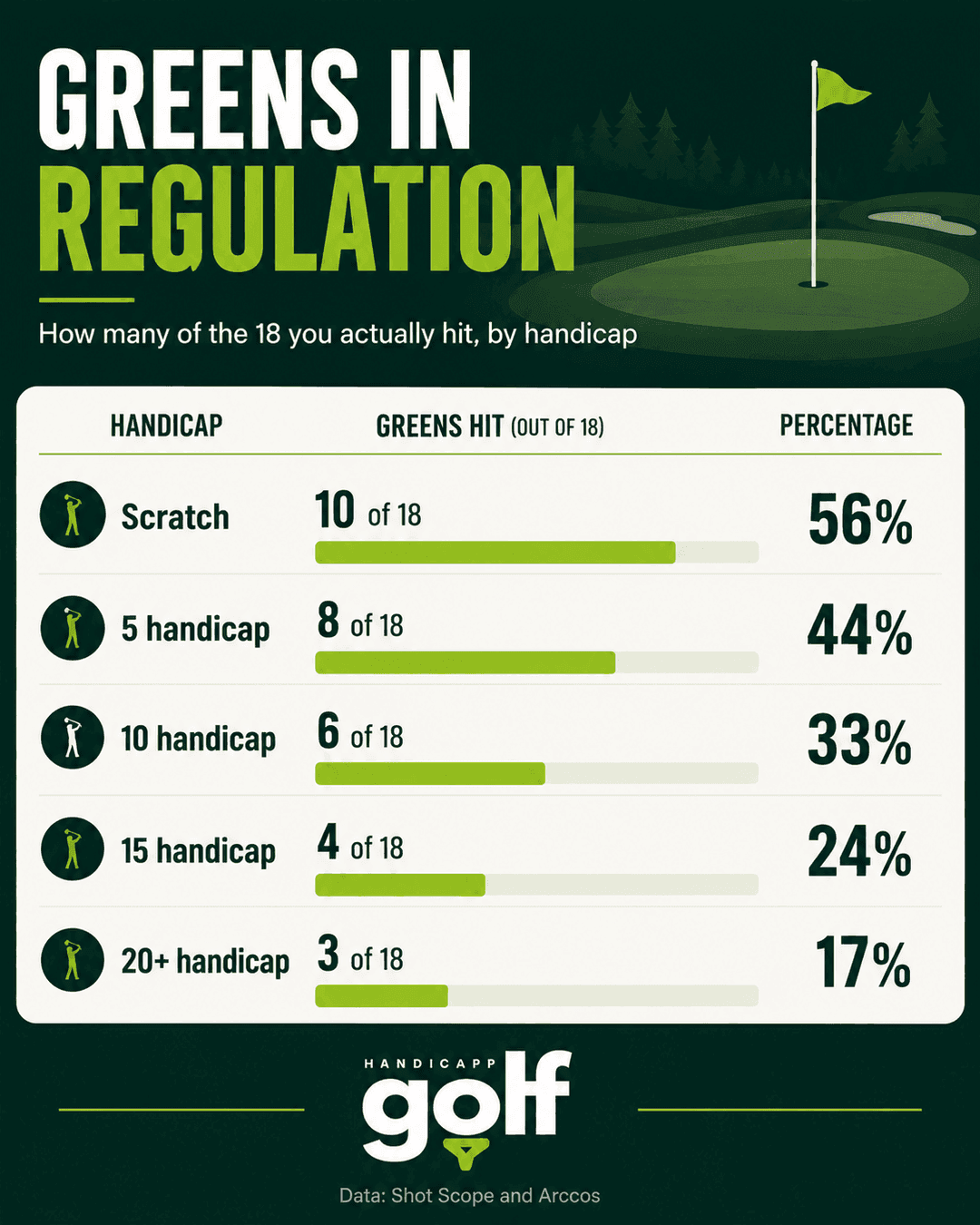
Greens in regulation is the number that tracks your handicap most closely, and it is lower than almost everyone thinks. A scratch golfer hits about 10 of 18, a 10 handicap around 6, a 15 handicap around 4, and a 20 plus handicap around 3. Missing greens is the normal state of amateur golf, so score from the ones you miss.
Greens in regulation, GIR for short, is the cleanest single measure of ball striking in golf. It counts the times you reach the green with two putts still in hand for par, and it correlates with handicap more tightly than driving distance or almost anything else. It is also the stat that most humbles golfers when they first see the real numbers. Below is greens in regulation by handicap, from tracked amateur rounds, and what it should change about how you play.
The numbers, by handicap
Here is the same chart written out. Read it as greens hit out of 18, and the share of greens that is.
| Handicap | Greens hit | Percentage |
|---|---|---|
| Scratch | 10 of 18 | 56% |
| 5 | 8 of 18 | 44% |
| 10 | 6 of 18 | 33% |
| 15 | 4 of 18 | 24% |
| 20+ | 3 of 18 | 17% |
Why the number is so much lower than you feel
Watch tour golf and the players hit greens all day, so we quietly assume a good amateur does the same. They do not. Even a scratch golfer misses eight greens a round. A 15 handicap hits the green in regulation on roughly one hole in four. That is not a flaw in your game, it is the game. Once you accept it, your strategy gets a lot simpler and a lot better.
Score from the greens you miss
If you are going to miss most greens, the shots are saved in two places: missing them in the right spots, and getting up and down when you do. Aim for the middle of the green rather than the flag, which turns a miss into a long putt instead of a short-sided bunker shot. The same logic runs through our post on what shot you should play and our guide to how to lower your golf handicap: avoiding the big number beats chasing the hero shot.
Track your greens hit, round by round
Log every round with Golf Handicapp. Free to use, with no subscription and no club membership needed.
Greens are won on approach, not power
The fastest way to hit more greens is better approach play, not extra yards off the tee. From 100 yards even a scratch golfer only finds the green about 70 percent of the time, which we broke down in how often golfers hit the green from 100 yards. Knowing your real carry numbers helps more than trying harder, and our golf club distance charts give you a realistic starting point by ability.
Know your own greens hit
These are averages across thousands of rounds. Yours are your own, and the only way to learn them is to log your golf. Once you are tracking, you can watch your greens hit climb as your striking improves, and check your handicap at the same time with our WHS handicap calculator. Every round you post in a Golf Handicapp tournament counts toward your handicap too.
Common questions
What is a green in regulation?+
A green in regulation, or GIR, means your ball is on the putting surface with at least two putts left for par. So the green in one shot on a par 3, in two on a par 4, and in three on a par 5. Hit the green in regulation and you have a birdie putt and a very likely par.
How many greens in regulation does an average golfer hit?+
Far fewer than most people expect. Tracked data puts a scratch golfer at around 10 greens in regulation a round, a 10 handicap at about 6, a 15 handicap at about 4, and a 20 plus handicap at around 3 out of 18. Even the best amateurs miss more greens than they hit.
How many greens does a 15 handicap hit?+
About 4 out of 18, roughly 24 percent. A 15 handicap misses three greens out of four, which is exactly why the short game and avoiding the big number matter so much more than chasing pins.
Is greens in regulation the best predictor of score?+
It is one of the strongest. GIR tracks tightly with handicap because it rewards both driving and approach play at once. Improve your greens hit per round and your scores follow, which is why it is worth tracking alongside your handicap.
Keep reading

About the author
Claudia Laurent · Golf writer, Golf Handicapp
Claudia writes about the World Handicap System, golf scoring and getting more from every round for Golf Handicapp. She is a mid-handicap golfer who logs every card, the good ones and the ones she would rather forget.
Last updated 12 July 2026.