
Claudia Laurent
Golf writer, Golf Handicapp · 12 July 2026
The short answer
Most golfers think they lose their shots on the greens. The strokes-gained data says the opposite. At every handicap, from a 10 to a 25, approach play is the biggest leak and putting is the smallest. If you want to shoot lower scores, the practice ground to live on is the one with a target 120 to 180 yards away.
It is the most misunderstood thing in amateur golf. Ask a 20 handicap where their shots go and most will blame their putting, or a wristy chip, or the driver. Strokes gained, the analysis Mark Broadie built for his book Every Shot Counts, tells a clearer story. When you measure the gap between an amateur and a scratch golfer and split it by part of the game, the same pattern shows up at every level. Here is where your shots really go.
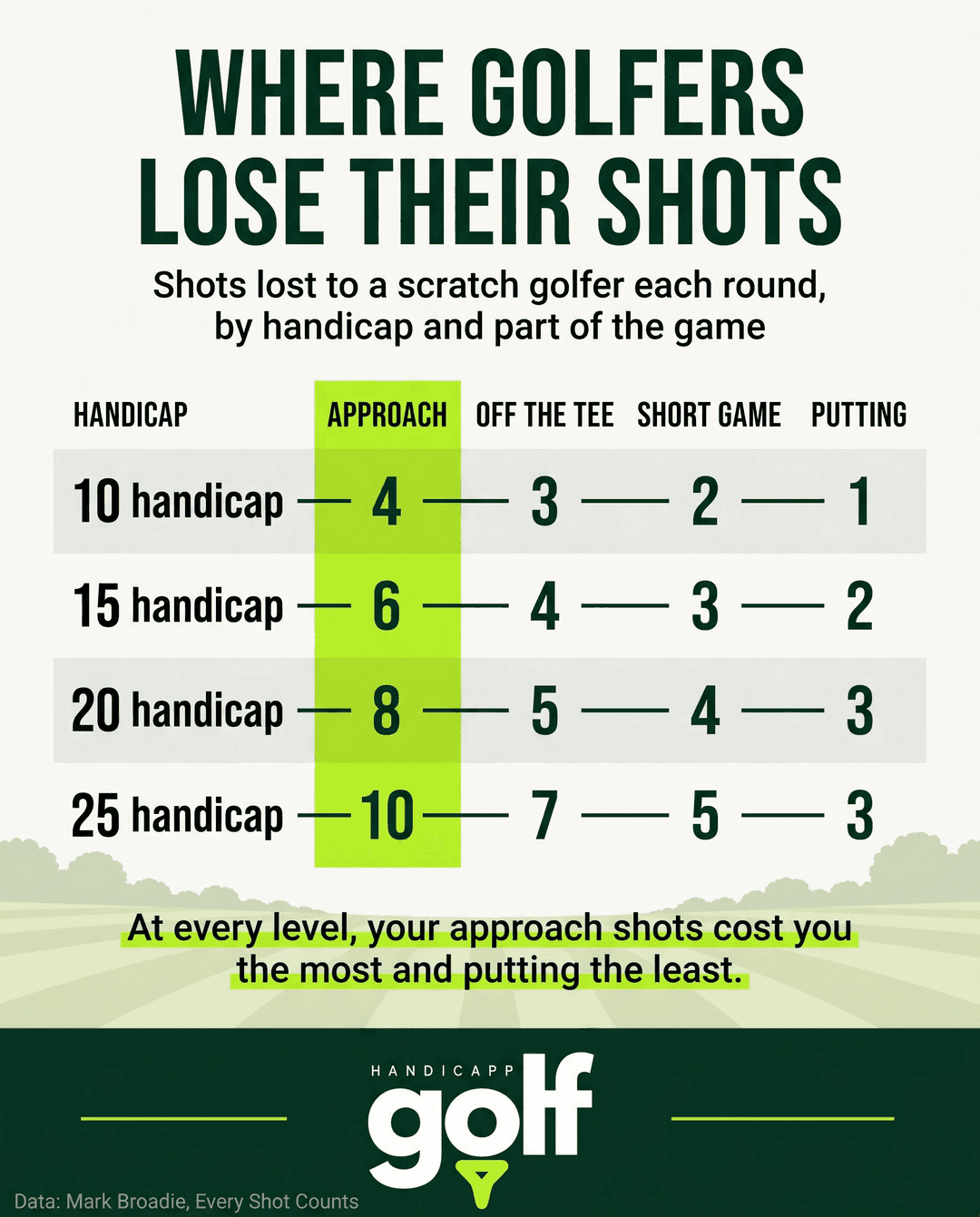
Shots lost to a scratch golfer, by area
Read each row as the shots a golfer of that handicap gives away to a scratch player over a round, split by part of the game. The rows add up to the handicap, and the shape is the same all the way down.
| Handicap | Approach | Off the tee | Short game | Putting |
|---|---|---|---|---|
| 10 | 4 | 3 | 2 | 1 |
| 15 | 6 | 4 | 3 | 2 |
| 20 | 8 | 5 | 4 | 3 |
| 25 | 10 | 7 | 5 | 3 |
Approach play is the biggest leak, every time
Look down the approach column. It is the largest number in every row, and the gap only grows as handicap rises. A 25 handicap loses about 10 shots a round to a scratch golfer on approach alone. This is the full-swing shot into the green, from 120 to 180 yards, and it is where the strokes are hiding. It matches what we found in greens in regulation by handicap: hitting more greens is the single biggest scoring lever you have.
Putting is the smallest gap, not the biggest
Now look at the putting column. It is the smallest number in every row. The 25 handicap gives away about 3 shots on the greens, less than a third of the approach gap. Putting feels like where rounds are lost because we remember the misses, but the data is unambiguous. This does not mean putting is worthless, it means it is the wrong place to spend most of your practice if your goal is a lower handicap.
See which part of your game is costing you
Track every round with Golf Handicapp. Free, forever. No card, no subscription, no club required.
Where to spend your practice time
The takeaway writes itself. Spend your range time on the full swing into a target, not on lag putts. Knowing your real carry numbers is half the battle, which is why our golf club distance charts and the reality of how often you hit the green from 100 yards matter so much. Off the tee, keeping the ball in play beats chasing distance, and our guide to how to lower your golf handicap puts it all in order.
Find your own leaks
These figures are the averages. Your own split will be personal, and the only way to find your biggest leak is to log your rounds and look. Once you are tracking, you can watch the gaps close and check your handicap at the same time with our WHS handicap calculator. Every round you post in a Golf Handicapp tournament counts toward your handicap too.
Common questions
Where do amateur golfers lose the most shots?+
On approach shots. Strokes-gained analysis of amateur play shows that at every handicap the biggest gap to a scratch golfer is on approach, the full shots into the green from the fairway and rough. It is a bigger leak than driving, short game and putting.
Is putting where high handicappers lose their strokes?+
No, and this is the myth the data kills. Putting is the smallest gap at every handicap. A 25 handicap gives away around 3 shots a round on the greens but around 10 on approach. Practising putting feels productive, but approach play is where the shots really are.
What should I practise to lower my handicap fastest?+
Approach play and tee-to-green ball striking, because that is where the strokes are hiding. Knowing your real carry distances, hitting more greens, and keeping the ball in play off the tee move your score more than any amount of putting drills.
What is strokes gained?+
Strokes gained, developed by Mark Broadie, measures every shot against what a benchmark player would average from the same spot, so it can tell you exactly which part of your game is costing you strokes rather than relying on feel. This chart uses it to split the gap to a scratch golfer by area.
Keep reading

About the author
Claudia Laurent · Golf writer, Golf Handicapp
Claudia writes about the World Handicap System, golf scoring and getting more from every round for Golf Handicapp. She is a mid-handicap golfer who logs every card, the good ones and the ones she would rather forget.
Last updated 12 July 2026.