
Claudia Laurent
Golf writer, Golf Handicapp · 6 July 2026
The short answer
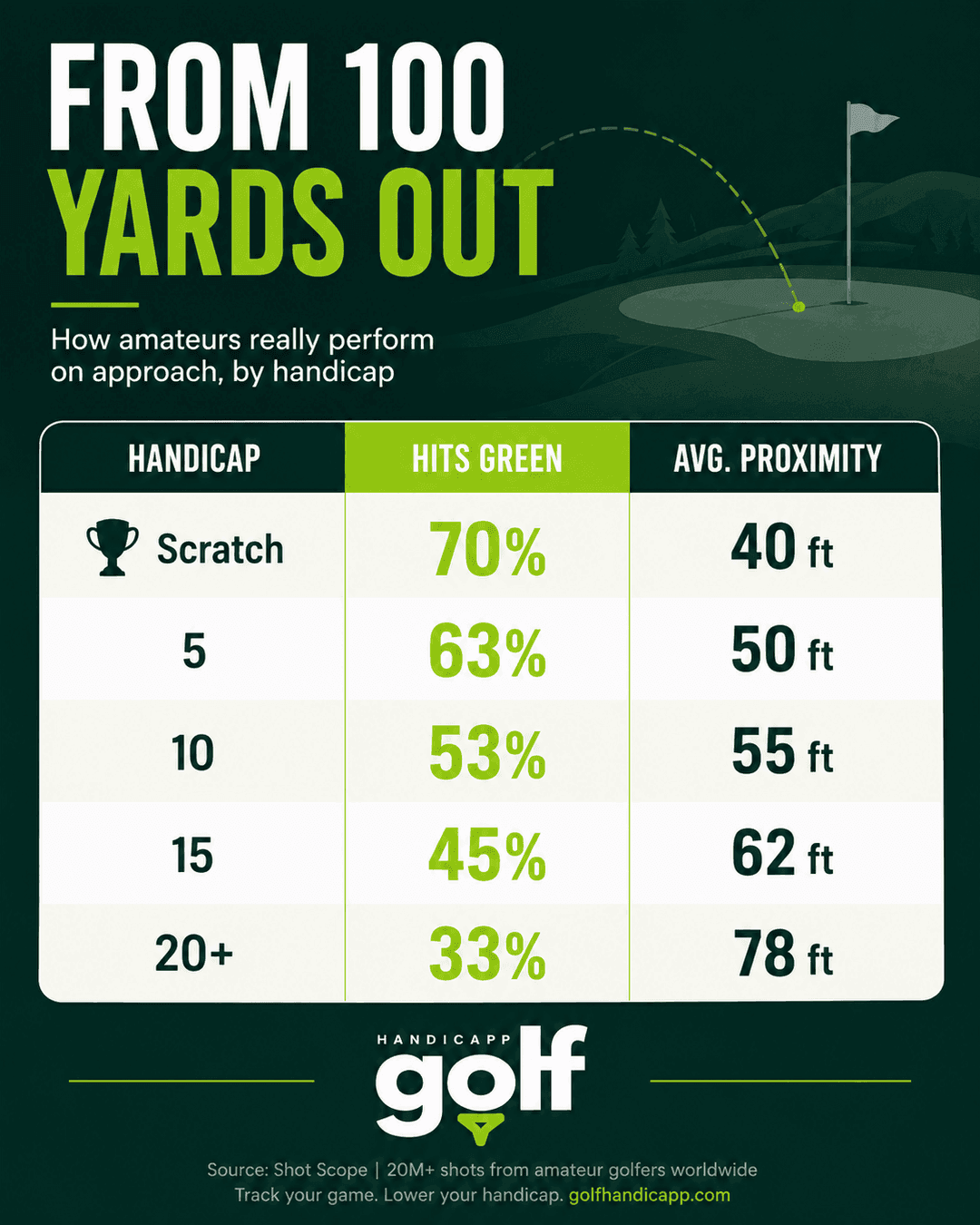
From 100 yards on the fairway, a scratch golfer hits the green about 70 percent of the time, a 15 handicap under half, and a 20 plus handicap around a third. Even the best players leave themselves roughly 40 feet on average. From 100 yards, almost nobody stiffs it as a rule, so aim for the middle and expect a two-putt.
Ask a golfer how they will do from 100 yards and most will tell you it is a wedge, a scoring club, a shot they expect to hit close. The tracked data tells a more humbling story. Below is how amateurs really perform on approach from 100 yards, broken down by handicap, and what it means for how you should actually play the shot. It is worth knowing before you next stand over a wedge feeling like par is a formality.
What the data really says
The pattern is a clean, steep line. Every step down in handicap buys both a better chance of finding the green and a shorter putt when you do. Here is the same chart in numbers, for a clean fairway lie at 100 yards.
| Handicap | Hits green | Avg. proximity |
|---|---|---|
| Scratch | 70% | 40 ft |
| 5 | 63% | 50 ft |
| 10 | 53% | 55 ft |
| 15 | 45% | 62 ft |
| 20+ | 33% | 78 ft |
The 50/50 line sits around a 12 to 15 handicap
This is the number that surprises people most. A mid handicapper is roughly a coin flip to hit the green from 100 yards, and that is on a good lie in the fairway. If you play off 15 and you have ever felt like you leak too many wedges, you are not doing anything unusual. You are performing exactly as the data expects. The fix is not a swing overhaul, it is a target, and we come to that below.
Even scratch golfers miss, and rarely stiff it
Look at the top row again. A scratch golfer, a genuinely excellent player, still misses the green from 100 yards almost a third of the time, and when they hit it they are leaving about 40 feet on average. That is a lag putt for birdie, not a tap in. Tour broadcasts warp our sense of this, because we only ever see the shots that finish close. From 100 yards, nobody hits it stiff on demand.
See your own approach numbers, hole by hole
Track every round with Golf Handicapp. Free to use, with no subscription and no club membership needed.
What to actually do with this
Once you accept the real odds, the smart play becomes obvious. Aim at the middle of the green, not the flag. The middle is the biggest target you have, and it turns your misses into the fat of the green rather than short-siding you in a bunker. Expect a two-putt from range and you will three-putt far less often, because you are lagging the first one rather than charging at a hole you were never that likely to get close to. This is the same logic behind our guide to how to lower your golf handicap: avoiding the big number beats chasing the hero shot. Our post on what shot you should play turns that into a simple on-course checklist.
Trust a real distance, not a hopeful one
Half the missed wedges from 100 yards are distance errors, not direction errors, and they usually come from guessing how far you actually carry each club rather than knowing. Our golf club distance charts show realistic carry numbers by ability, and picking the loft that matches the shot, covered in the wedge loft guide, does more for your proximity than any amount of trying harder.
Know your own numbers
These figures are the averages across millions of shots. Yours will be your own, and the only way to know them is to log your rounds. Once you are tracking, you can see your real green-hit rate from 100 yards, watch it climb as your game tightens, and check what your handicap is doing at the same time with our WHS handicap calculator. If you play society days and trips, every round you log in a Golf Handicapp tournament counts toward your handicap too.
Common questions
What percentage of greens do amateurs hit from 100 yards?+
On a clean fairway lie, a scratch golfer hits the green from 100 yards around 70 percent of the time, a 10 handicap around 53 percent, a 15 handicap around 45 percent, and a 20 plus handicap around a third of the time. These figures come from Shot Scope tracking of more than 20 million amateur shots.
Is 100 yards a scoring club for most golfers?+
It is a scoring distance, but not the gimme most players assume. Even when the green is hit, the average approach from 100 yards finishes well outside tap-in range, from about 40 feet for a scratch golfer to 78 feet for a high handicap. Think of it as a two-putt distance, not a one-putt one.
Why do I miss so many wedges from 100 yards?+
Usually because expectations are set by tour golf, not by the data. A missed green from 100 yards is completely normal even for good players. The gains come from taking dead aim at the middle of the green rather than the flag, and from a repeatable distance you can trust.
Do the numbers get worse from the rough?+
Yes. Every figure here assumes a fairway lie. From the rough or an awkward stance the green-hit rate drops further and the average proximity grows, which is why keeping the ball in play off the tee quietly saves more shots than chasing distance.
Keep reading

About the author
Claudia Laurent · Golf writer, Golf Handicapp
Claudia writes about the World Handicap System, golf scoring and getting more from every round for Golf Handicapp. She is a mid-handicap golfer who logs every card, the good ones and the ones she would rather forget.
Last updated 6 July 2026.