
Claudia Laurent
Golf writer, Golf Handicapp · 4 July 2026
The short answer
Smart choices save more shots than perfect swings. In trouble, take your medicine. When you can reach safely, play to your best miss. When you cannot, lay up to a full number. Aim at the middle of the green, not the tucked flag, club up in the wind, and leave the hero shot for the range. Better decisions, better scores.
Most golfers do not lose shots because their swing let them down. They lose them by making the wrong decision, going at a flag they had no business attacking, taking on a carry that was never on, or trying to rescue one mistake with a shot that turns it into three. Good course management is simply a short list of sensible questions asked before every shot. Here is that list, laid out as the decision tree below, so you always know the smart play.
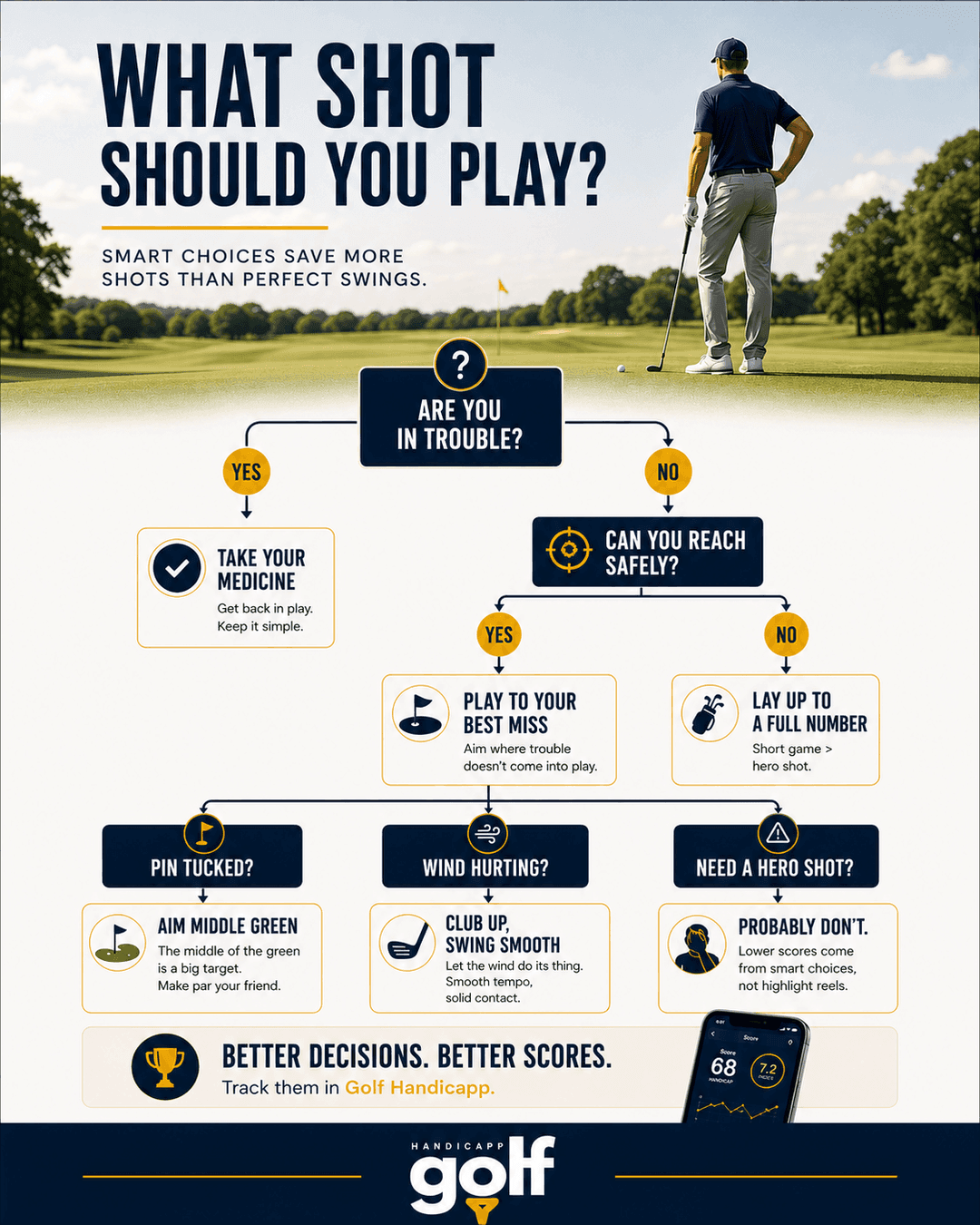
The decisions, one by one
Run through these before you pull a club. None of them ask you to hit a better shot than you can, they just point you at the smart one.
| Ask yourself | The smart play | Why |
|---|---|---|
| Are you in trouble? | Take your medicine | Get back in play with a simple shot. One bad shot should stay one bad shot. |
| Can you reach safely? | Play to your best miss | Aim where trouble does not come into play, so even your miss is fine. |
| Cannot reach safely? | Lay up to a full number | A committed wedge beats a hero shot. Short game over glory. |
| Pin tucked? | Aim middle green | The middle is a big target. Make par your friend. |
| Wind hurting? | Club up, swing smooth | Let the wind do its thing. Smooth tempo, solid contact. |
| Need a hero shot? | Probably do not | Lower scores come from smart choices, not highlight reels. |
In trouble? Take your medicine
The single most expensive habit in amateur golf is trying to pull off a miracle from the trees or the deep rough. The odds are poor and the downside is a double or worse. When you are in trouble, the first job is to get safely back in play, even if it means going sideways. One bad shot should cost you one shot, not three. Accept the bogey that is on offer and move on.
Can you reach safely? Play your best miss
When the shot is on, think about your miss before your target. Aim at the part of the hole where even a slightly wayward shot stays out of trouble, which usually means favouring the open side away from bunkers and water. This is where knowing your own shot shape pays off, and our post on golf shot shapes helps you aim to allow for the curve you actually hit.
Cannot reach? Lay up to a full number
If you cannot get there safely, do not force it. Lay up to a yardage you love, a full wedge or a comfortable number, rather than leaving yourself an awkward half shot. A committed wedge from 90 yards will beat a stretched long iron over trouble almost every time. Choosing that number relies on knowing your carries, which is exactly what the club distance charts are for.
Play smarter and let your handicap fall
Track every round with Golf Handicapp. Logging rounds and your handicap are free, always.
On approach? Aim at the middle
When you reach a green, the middle is almost always the right target. It is the biggest, safest area, and it leaves you a putt from anywhere rather than a nervy chip from short-side rough. Firing at a tucked flag is a low-percentage play that only tempts the trouble tucked beside it. As the data in how often you hit the green from 100 yards shows, even good players do not hit it close on demand, so make par your friend and take the two-putt.
In the wind? Club up and swing smooth
Wind tempts golfers into swinging harder, which adds spin and makes the ball balloon and come up short. The better answer is to take more club and swing smoothly, letting the wind do its work while you keep your tempo and contact. A three-quarter shot with an extra club flies more predictably than a full-blooded one into a breeze.
The hero shot? Probably not
It is worth saying plainly: lower scores come from smart choices, not highlight reels. The spectacular recovery you pull off once in ten tries costs you the other nine. Play the percentages, take your pars and bogeys, and let the good scores come from a tidy card rather than one heroic swing. That mindset is the quiet engine behind our guide on how to lower your golf handicap, and the effect shows up fast when you track your rounds with the WHS handicap calculator. Playing a society day or a trip? Every round in a Golf Handicapp tournament counts toward your handicap too.
Common questions
What is course management in golf?+
It is the art of choosing shots that give you the best score, not the most spectacular result. It means aiming at the biggest safe target, playing to your reliable miss, laying up when the reward is not worth the risk, and taking your medicine when you are in trouble rather than trying to be a hero.
Should I aim at the flag or the middle of the green?+
For most golfers, the middle of the green almost every time. The middle is a big target that leaves a putt from anywhere, while firing at a tucked flag brings bunkers and short-side chips into play. Make par your friend and let the occasional close one be a bonus.
When should I lay up instead of going for it?+
When you cannot reach safely. If the carry is at the edge of your range or trouble guards the miss, lay up to a full number you are comfortable with, because a good wedge from 90 yards beats a gamble that finds the water. Your short game is more reliable than the hero shot.
Does course management really lower scores?+
Yes, often more than swing changes. Most wasted shots come from avoidable decisions, going at pins, taking on carries that are not on, compounding one bad shot with a risky recovery. Smarter choices cut those out and your handicap follows.
Keep reading

About the author
Claudia Laurent · Golf writer, Golf Handicapp
Claudia writes about the World Handicap System, golf scoring and getting more from every round for Golf Handicapp. She is a mid-handicap golfer who logs every card, the good ones and the ones she would rather forget.
Last updated 4 July 2026.