
Claudia Laurent
Golf writer, Golf Handicapp · 6 July 2026
The short answer
These charts show realistic carry distances for every club, from beginner to tour level, for both men and women. Use them for the gaps between your clubs, not as a target to live up to. All numbers are carry yards, and your own distances are the ones that matter when you are picking a club.
Nearly every golfer overestimates how far they hit it, usually by remembering their single best strike and quietly forgetting the other nine. That is why so many approach shots come up short: the club choice was based on a hopeful number, not a real one. These distance charts, built from Shot Scope tracking and tour launch data, give you an honest reference by ability level so you can gap your bag properly and start clubbing up when you need to. Log a few rounds in Golf Handicapp and you will soon know your own figures, which beat any chart.
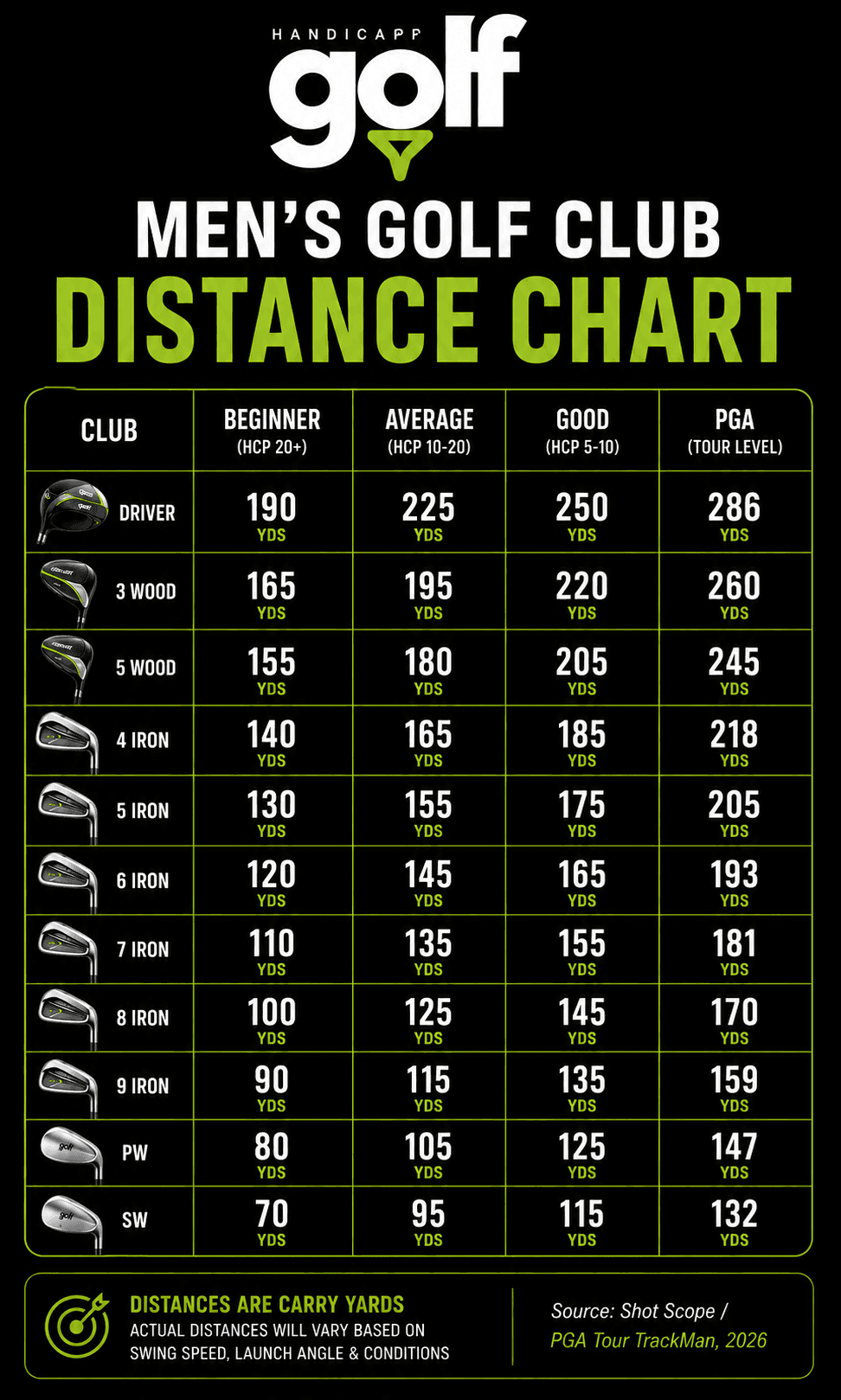
Men's golf club distance chart
Carry distances in yards, grouped by ability. “Beginner” is roughly a 20 plus handicap, “Average” a 10 to 20, “Good” a 5 to 10, and the final column is PGA Tour level for reference.
| Club | Beginner (20+) | Average (10 to 20) | Good (5 to 10) | PGA Tour |
|---|---|---|---|---|
| Driver | 190 | 225 | 250 | 286 |
| 3 Wood | 165 | 195 | 220 | 260 |
| 5 Wood | 155 | 180 | 205 | 245 |
| 4 Iron | 140 | 165 | 185 | 218 |
| 5 Iron | 130 | 155 | 175 | 205 |
| 6 Iron | 120 | 145 | 165 | 193 |
| 7 Iron | 110 | 135 | 155 | 181 |
| 8 Iron | 100 | 125 | 145 | 170 |
| 9 Iron | 90 | 115 | 135 | 159 |
| PW | 80 | 105 | 125 | 147 |
| SW | 70 | 95 | 115 | 132 |
Women's golf club distance chart
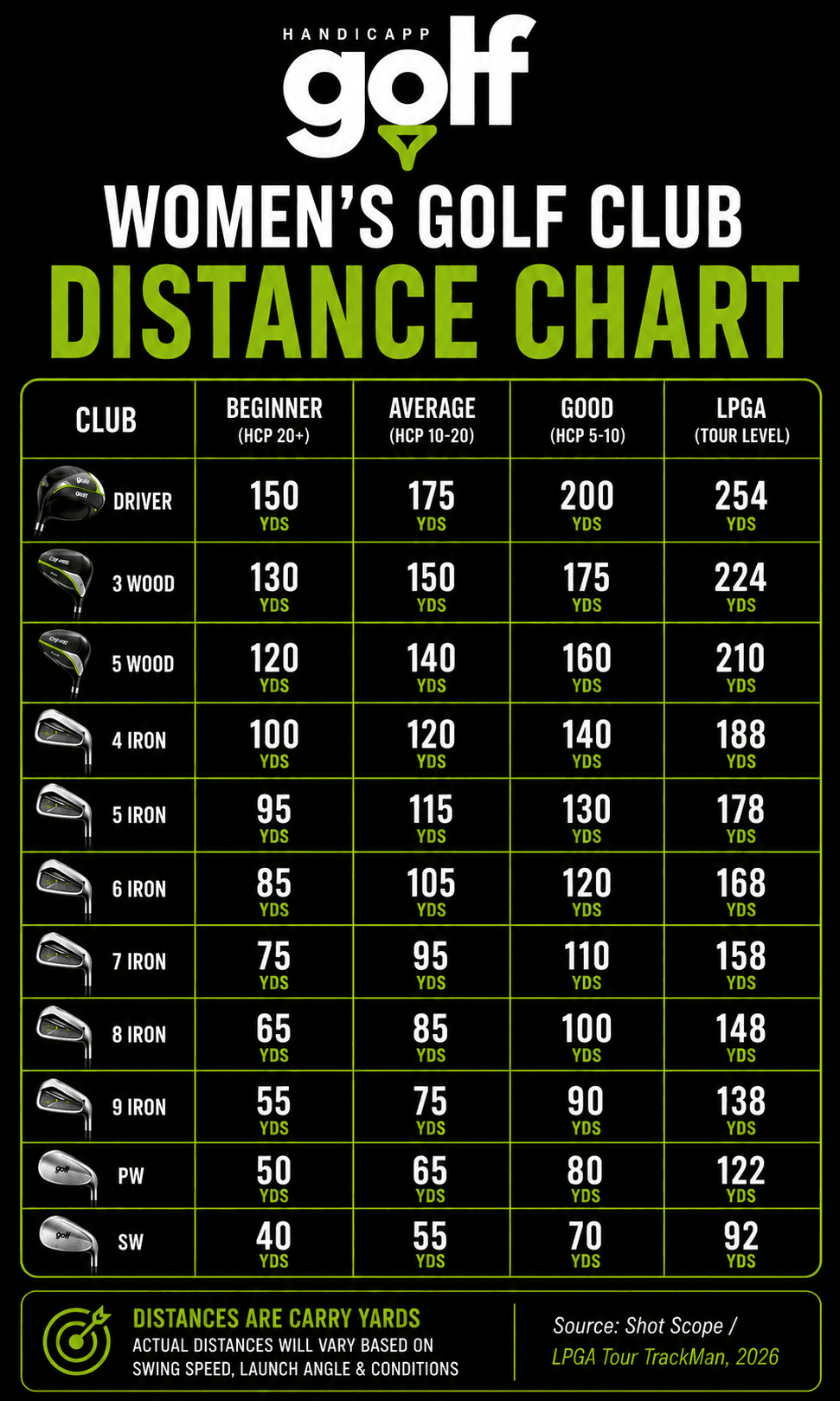
The same layout for women, with the final column set to LPGA Tour level. As with the men's chart, these are carry distances and a reference for gapping, not a scorecard.
| Club | Beginner (20+) | Average (10 to 20) | Good (5 to 10) | LPGA Tour |
|---|---|---|---|---|
| Driver | 150 | 175 | 200 | 254 |
| 3 Wood | 130 | 150 | 175 | 224 |
| 5 Wood | 120 | 140 | 160 | 210 |
| 4 Iron | 100 | 120 | 140 | 188 |
| 5 Iron | 95 | 115 | 130 | 178 |
| 6 Iron | 85 | 105 | 120 | 168 |
| 7 Iron | 75 | 95 | 110 | 158 |
| 8 Iron | 65 | 85 | 100 | 148 |
| 9 Iron | 55 | 75 | 90 | 138 |
| PW | 50 | 65 | 80 | 122 |
| SW | 40 | 55 | 70 | 92 |
Learn your real distances, round by round
Track every shot with Golf Handicapp. Logging rounds and your handicap are free, always.
Why carry, not total
Every number here is carry, the distance the ball flies before it lands. Total distance adds roll, which changes with how firm the ground is and tells you very little about how to attack a green. When you are flying a bunker or a front edge, carry is the only number that matters. Gap your clubs by carry and your distance control into greens gets far more reliable, which is exactly what turns those 100 yard approaches, covered in how often golfers hit the green from 100 yards, into greens hit rather than greens missed.
Mind the gaps, not the totals
The most useful thing in these charts is not any single distance, it is the spacing between clubs. You want a consistent gap, roughly 10 to 15 yards for most players, so that every yardage on the course has a club. Big overlaps or holes in your gapping leave you stuck between clubs on approach, and that costs greens. This matters most in the scoring clubs, which is why choosing the right wedge lofts, set out in the wedge loft guide, is worth getting right.
Your own numbers beat the chart
Treat these figures as a sensible starting point, then replace them with your own. Note the club and the distance left on every clean approach, build the average across a few rounds, and you will have a personal chart that reflects your swing, your ball and the courses you play. As your strike improves those numbers climb, and you can keep an eye on your handicap moving in the right direction with our WHS handicap calculator. If you want the fuller plan, our guide on how to lower your golf handicap puts distance control in its proper place.
Common questions
How far should the average golfer hit each club?+
An average male golfer, roughly a 10 to 20 handicap, carries a driver about 225 yards, a 7 iron about 135 yards and a pitching wedge about 105 yards. An average female golfer carries a driver about 175 yards, a 7 iron about 95 yards and a pitching wedge about 65 yards. These are carry distances, not total, and every golfer is different.
Are these carry distances or total distances?+
They are carry distances, meaning how far the ball flies through the air before it lands. Total distance adds roll, which varies hugely with the firmness of the ground. Gapping your clubs by carry is far more reliable, especially into greens.
Why do I hit it shorter than the chart?+
Because most published distances come from clean strikes at a decent swing speed. Real course distances vary with the lie, the wind, the temperature, the ball and how well you catch it. Use the chart as a reference for the gaps between your clubs, then learn your own numbers by tracking real shots.
How do I find my own club distances?+
Hit shots on a launch monitor if you can, or simply note the club and the distance left every time you have a clear approach, and build the average over a handful of rounds. Your real gaps matter more than any chart, and they are the foundation of good club selection.
Keep reading

About the author
Claudia Laurent · Golf writer, Golf Handicapp
Claudia writes about the World Handicap System, golf scoring and getting more from every round for Golf Handicapp. She is a mid-handicap golfer who logs every card, the good ones and the ones she would rather forget.
Last updated 6 July 2026.