
Claudia Laurent
Golf writer, Golf Handicapp · 23 October 2026
The short answer
One round leaves behind one number, its score differential. That number joins your last 20. Only the best 8 of those count, and their average is your handicap index. Not your average score, not your best score, the average of your best 8 from your last 20.
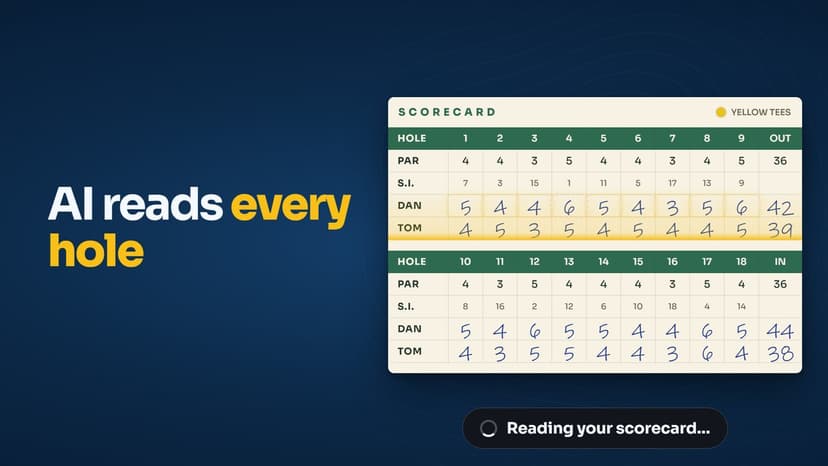
Most golfers know their handicap and have no idea where it comes from. It is not a black box. There are three steps, the film above does them in 23 seconds, and once you have seen them you will know exactly why a bad round sometimes changes nothing and a good one moves you straight away.
Step one: the round becomes a differential
Every round is turned into a score differential, which strips out how hard the course was so that an 86 at a brute and an 86 at a pitch and putt are not treated the same. The formula is:
(score minus course rating) times 113, divided by slope rating
In the film the round is an 86 from tees rated 71.4 with a slope of 128. That is 14.6 over the rating, times 113, divided by 128, which comes out at 12.9. The 113 is simply the slope of a course of standard difficulty, so a differential is your performance expressed as if every course were that one.
| Step | In the film | What it is |
|---|---|---|
| Your score | 86 | Adjusted gross score, with any hole capped at net double bogey |
| Course rating | 71.4 | What a scratch golfer is expected to shoot from those tees |
| Slope rating | 128 | How much harder the tees play for a bogey golfer than for scratch |
| Score differential | 12.9 | (86 minus 71.4) times 113, divided by 128 |
| Best 8 of your last 20 | Average | Only the lowest 8 differentials count |
| Handicap index | 12.3 | The average of those 8, rounded to one decimal |
Step two: it joins your last 20, and only the best 8 count
The differential goes into your scoring record alongside your last 19. Of those 20, the system picks the lowest 8 and ignores the other 12. They are still there, and one of them will count the day a better round pushes a low one out, but right now they do nothing. This is why your handicap represents your potential rather than your average day.
Step three: the average of the 8 is your index
Average the best 8, round to one decimal, and that is your handicap index. In the film it is 12.3. A bad round only hurts if it knocks a good one out of the 20. A good round helps the moment it is low enough to be one of the 8. That is the whole system, and the full WHS guide covers the two details the film leaves out: the caps that stop an index rising more than five shots above your low point in a year, and the smaller sample used before you have 20 rounds.
See the maths on every round you post
Golf Handicapp shows the differential for each round and which 8 are counting right now. A real handicap, free, with nothing hidden.
From index to the number you play off
Your index travels with you. On the day it becomes a course handicap for the tees you are playing: index times slope divided by 113, plus the difference between course rating and par. A 12.3 on a 128 slope is a 14 before any competition allowance. Try it on our WHS handicap calculator.
Common questions
What is a score differential?+
The number one round leaves behind. Take your adjusted gross score, subtract the course rating, multiply by 113 and divide by the slope rating. An 86 on a course rated 71.4 with a slope of 128 gives (86 minus 71.4) times 113 divided by 128, which is 12.9.
Is my handicap the average of my last 20 rounds?+
No. It is the average of the best 8 differentials from your last 20. The other 12 rounds sit in your record but do not count toward the index until a better round pushes one of the 8 out.
Why did a bad round not change my handicap?+
Because it did not make the best 8. A bad round only hurts when it knocks a good round out of your last 20, so an old low differential drops off the back of the record and a higher one takes its place in the 8.
Do I need 20 rounds before I get a handicap?+
No. From three 18-hole rounds (54 holes) you get an index, worked out from a smaller sample with a small adjustment, and it scales up to the full 8 of 20 as your record fills in.
Keep reading

About the author
Claudia Laurent · Golf writer, Golf Handicapp
Claudia writes about the World Handicap System, golf scoring and getting more from every round for Golf Handicapp. She is a mid-handicap golfer who logs every card, the good ones and the ones she would rather forget.
Last updated 23 October 2026.