
Claudia Laurent
Golf writer, Golf Handicapp · 29 July 2026
The short answer
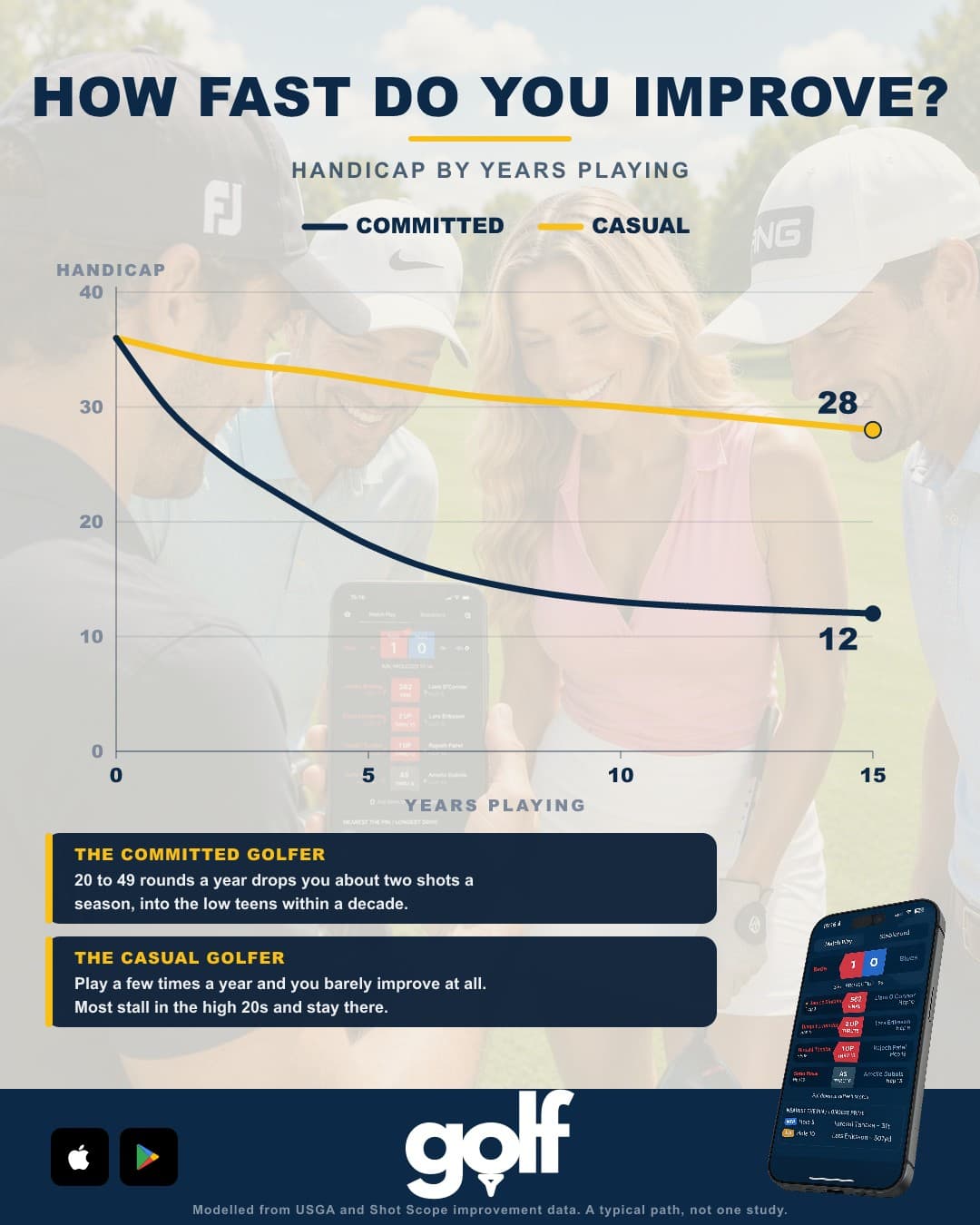
It comes down to how much you play. A committed golfer, 20 to 49 rounds a year, can fall from a 36 into the low teens within a decade, dropping around two shots a season. A casual golfer, out a handful of times a year, barely moves and usually stalls in the high 20s for good. Frequency of play is the whole game.
Every new golfer wants to know the same thing: how quickly will I get good? The honest answer is that it depends almost entirely on how often you play. Below is a typical improvement curve modelled from USGA and Shot Scope data, splitting golfers into two camps, and it shows just how differently the two paths unfold.
Committed vs casual, by years playing
Both golfers start in the same place. Within a few seasons the paths split hard, and by a decade in they are a different sport apart.
| Years playing | Committed (20-49/yr) | Casual (a few/yr) |
|---|---|---|
| Start | 36 | 36 |
| 5 years | ~20 | ~33 |
| 10 years | ~14 | ~30 |
| 15 years | 12 | 28 |
The committed golfer
Twenty to forty-nine rounds a year, and improvement compounds. You lose about two shots a season in the early years, and within a decade you are into the low teens. Nothing about it is fast, but it is steady, and it is available to anyone who keeps showing up. The curve flattens as you go, which is why the last few shots down to single figures are the hardest won of all.
The casual golfer
Play a few times a year and you barely improve at all. Each round starts with knocking off the rust from the last one, so you spend your golf getting back to level rather than moving forward. Most casual golfers settle in the high 20s and stay there, and there is nothing wrong with that if the golf is fun. It just is not a path to a low handicap.
Track every round and watch the curve
Log your golf with Golf Handicapp. Logging rounds and your handicap are free, always.
What actually moves the needle
Frequency first, everything else second. After that, spend more time on the short game than the range, because that is where golfers actually lose their shots, and keep tracking your rounds so you can see it happening. The golfers who improve are almost always the ones who know their own numbers.
Know your own curve
These are typical paths, not promises. The only way to see yours is to log your golf. Once you are tracking, you can watch your handicap fall with our WHS handicap calculator, and every round you post in a Golf Handicapp tournament counts toward it.
Common questions
How long does it take to get a single-figure handicap?+
For a committed golfer playing 20 to 49 rounds a year, dropping from beginner level into the low teens typically takes the best part of a decade, and getting to single figures a good bit longer. It is not fast for anyone. The players who get there are the ones who keep playing and keep tracking their scores, not the ones who buy a new driver every spring.
How many rounds a year do you need to play to improve?+
Improvement tracks closely with how much you actually play. Around 20 to 49 rounds a year is enough to keep dropping roughly two shots a season for the first several years. Below about a dozen rounds a year, most golfers barely move, because they spend each round re-learning what they lost since the last one.
Why do casual golfers stop improving?+
Playing a few times a year is enough to have fun but not enough to build lasting skill or consistency. Rust sets in between rounds, so a casual golfer spends much of each round getting back to where they were rather than moving forward. Most plateau in the high 20s and stay there for years.
Can you improve without playing more?+
Somewhat. Smarter practice inside 50 yards, better course management and simply tracking your rounds so you can see where the shots go will all help. But there is no real substitute for reps. The single biggest lever on the improvement curve is frequency of play.
Keep reading

About the author
Claudia Laurent · Golf writer, Golf Handicapp
Claudia writes about the World Handicap System, golf scoring and getting more from every round for Golf Handicapp. She is a mid-handicap golfer who logs every card, the good ones and the ones she would rather forget.
Last updated 29 July 2026.