
Claudia Laurent
Golf writer, Golf Handicapp · 5 July 2026
The short answer
Ball position moves from forward to back as your clubs get shorter. Driver sits forward off your lead heel, fairway woods and long irons just inside that, mid irons in the middle, and short irons and wedges just back of centre. Get it right and clean contact gets a lot easier.
Ball position is the least glamorous fundamental in golf and one of the most important. It costs nothing to fix, it happens before you even start the swing, and getting it wrong quietly causes a lot of thin and fat shots that get blamed on the swing instead. The simple idea is this: the club swings on an arc with one lowest point, and where the ball sits on that arc decides how you strike it. Here is where to play it for every club.
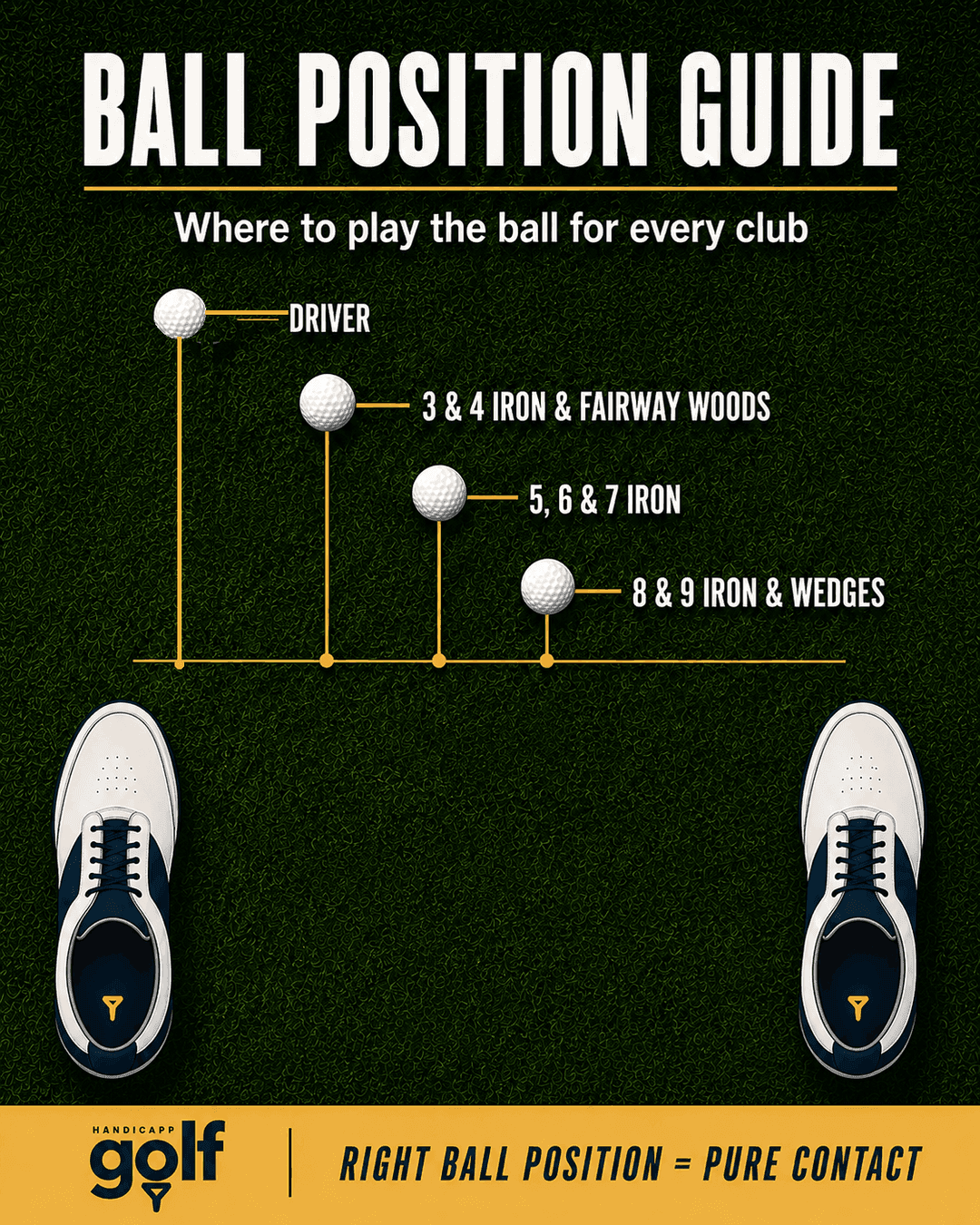
The four ball position zones
You do not need a different spot for all fourteen clubs. Think in four zones and you have the whole bag covered.
| Club | Ball position | Why |
|---|---|---|
| Driver | Forward, off the lead heel | Catch it slightly on the upswing for high launch and low spin. |
| 3 and 4 iron, fairway woods | Just inside the lead heel | Swept away near the bottom of the arc for a shallow, powerful strike. |
| 5, 6 and 7 iron | Around the middle | Struck with a slight downward blow, ball first then turf. |
| 8 and 9 iron, wedges | Just back of centre | A steeper, ball-first strike for control and spin. |
Driver: forward, catch it on the up
The driver is the exception in the bag. It is the one club you want to strike slightly on the upswing, because launching the ball high with low spin is how you carry it a long way. Playing it forward, roughly opposite the inside of your lead heel, lets the clubhead reach the ball just after the low point of the arc, sending it up off the tee. This ties directly into tee height, which we cover in the golf tee height guide.
Fairway woods and long irons: sweep it
Move the ball back a touch from the driver and you are looking for a sweeping strike near the very bottom of the arc. There is very little downward hit here, you are brushing the ball off the turf, which is why these clubs reward a shallow, unhurried swing.
Clean contact, lower scores, tracked every round
Log your golf with Golf Handicapp. Free to use, with no subscription and no club membership needed.
Mid and short irons: ball first, then turf
As the clubs get shorter, the ball moves back toward the centre. Mid irons sit around the middle of the stance for a slightly downward strike, and short irons and wedges sit just back of centre for a steeper, ball-first blow. That descending strike, catching the ball before the turf, is what compresses an iron and gives you the crisp contact and spin you are after. It is the same low-point idea explained in our post on the low point of the golf swing.
A simple way to check yourself
It is easy to drift out of position without noticing. Lay a club on the ground pointing at your target and another at right angles to it in practice, and you can see exactly where the ball sits relative to your stance. Get the setup right and the swing has far less to fix, which is the quiet theme running through our guide on how to lower your golf handicap. Track your rounds and watch the effect on your index with the WHS handicap calculator.
Common questions
Where should the ball be in my stance for a driver?+
Forward, roughly opposite the inside of your lead heel. The driver is the one club you want to catch slightly on the upswing, and a forward ball position lets the club reach the ball after it has passed its lowest point.
Where should the ball be for irons?+
It moves back as the club gets shorter. Mid irons sit around the middle of your stance, and short irons and wedges sit just back of centre. That lets you strike the ball first and the turf second, which is what produces crisp iron shots.
Should ball position change for every single club?+
Not in tiny steps. Think in a few groups: driver forward, fairway woods and long irons just inside that, mid irons centre, and short irons and wedges just back of centre. Those four zones cover the whole bag without overthinking it.
How does ball position affect contact?+
Hugely. The club travels on an arc with one lowest point, so where the ball sits on that arc decides whether you catch it on the way down, at the bottom or on the way up. Wrong ball position is one of the most common causes of thin and fat shots.
Keep reading

About the author
Claudia Laurent · Golf writer, Golf Handicapp
Claudia writes about the World Handicap System, golf scoring and getting more from every round for Golf Handicapp. She is a mid-handicap golfer who logs every card, the good ones and the ones she would rather forget.
Last updated 5 July 2026.