
Claudia Laurent
Golf writer, Golf Handicapp · 4 July 2026
The short answer
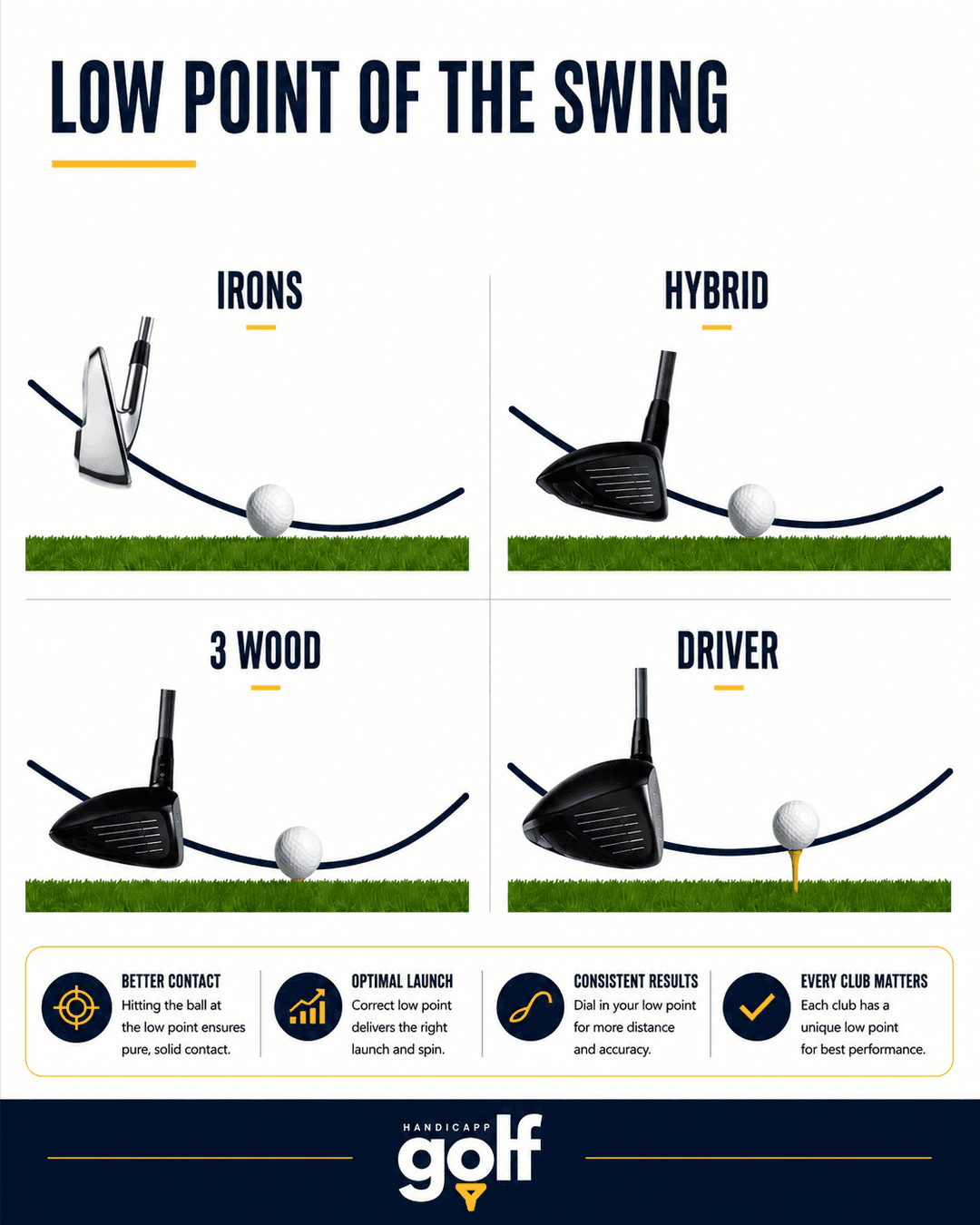
The clubhead swings on an arc with one lowest point. For irons that low point should sit just after the ball, so you hit ball first and take a divot in front. For fairway woods it sits at the ball, and for the driver it sits before the ball, so you catch it on the upswing. Match your strike to the club and clean contact follows.
Almost every contact problem in golf, the fat one that comes up short, the thin one that scuttles over the green, is really a low point problem. The good news is that once you understand where the bottom of your swing should be for each club, a lot of those misses explain themselves. This is one of the true fundamentals, and it quietly underpins ball striking far more than swing positions do.
Low point by club
The pattern moves steadily as the club changes. The shorter and more lofted the club, the more the low point sits in front of the ball and the more you strike down. The longer the club, the more the low point moves back toward and then behind the ball.
| Club | Low point | The strike |
|---|---|---|
| Irons | Just after the ball | Ball first, then a shallow divot. A descending strike compresses the ball. |
| Hybrid | At or just after the ball | A gentle downward brush, cleaner than an iron, no big divot. |
| Fairway wood | At the ball | Swept off the turf at the bottom of the arc, minimal downward hit. |
| Driver | Before the ball | Caught on the upswing off a tee for high launch and low spin. |
Irons: hit the ball, then the ground
With an iron you want the low point just after the ball, so the club is still travelling down when it meets the ball and only reaches the turf afterwards. That is what creates a divot in front of the ball and the solid, compressed strike that flies true and spins. Hit the ground first and you get the fat shot, catch the ball on the way up and you thin it. Ball first, turf second is the whole game with an iron.
Fairway woods and hybrids: sweep and brush
As you move to hybrids and fairway woods the low point creeps back to sit at the ball. You are sweeping the ball off the turf rather than trapping it, with little or no divot. A hybrid takes the gentlest of brushes, a fairway wood is swept clean at the very bottom of the arc. Trying to hit down hard on these longer clubs is a common cause of heavy, weak shots.
Turn cleaner contact into lower scores
Track every round with Golf Handicapp. Logging rounds and your handicap are free, always.
Driver: catch it on the way up
The driver flips the whole thing around. Teed up and played forward in the stance, you want to catch it after the low point, on the upswing, which launches the ball high with low spin for maximum carry. It is the one time you are deliberately hitting up, and it is why the driver setup feels so different to an iron. Tee height plays straight into this, covered in the golf tee height guide.
The quickest way to move your low point
The fastest lever is ball position. Too far forward and the low point arrives behind the ball, so you hit it fat, too far back and you catch it thin. Our ball position guide sets out where each club should sit, and pairing that with a stable, forward-moving strike fixes most contact issues without touching your actual swing. Clean strikes lead to more greens, which is the theme of how to lower your golf handicap, and you can see the payoff in your numbers with the WHS handicap calculator.
Common questions
What is the low point of the golf swing?+
It is the lowest point of the arc the clubhead travels on. Where the ball sits relative to that point decides your contact. For irons the low point should be just after the ball, so you strike ball first then turf. For the driver it should be before the ball, so you catch it on the way up.
Why do I keep hitting my irons fat?+
Usually because the low point is arriving behind the ball, so the club hits the ground first. That often traces back to the ball being too far forward, weight hanging on the back foot, or the body stalling through impact. Getting the low point ahead of the ball is the fix.
Should I hit down on my irons?+
Yes, slightly. A good iron strike catches the ball first with the club still descending, then takes a shallow divot after the ball. That is not a violent chop, it is a low point that sits just in front of the ball, which is why ball position matters so much.
Is the driver different?+
Very. The driver is teed up and played forward so you catch it just after the low point, on the upswing. That upward strike launches the ball high with low spin, which is how you carry it a long way. It is the opposite feeling to an iron.
Keep reading

About the author
Claudia Laurent · Golf writer, Golf Handicapp
Claudia writes about the World Handicap System, golf scoring and getting more from every round for Golf Handicapp. She is a mid-handicap golfer who logs every card, the good ones and the ones she would rather forget.
Last updated 4 July 2026.