
Claudia Laurent
Golf writer, Golf Handicapp · 4 July 2026
The short answer
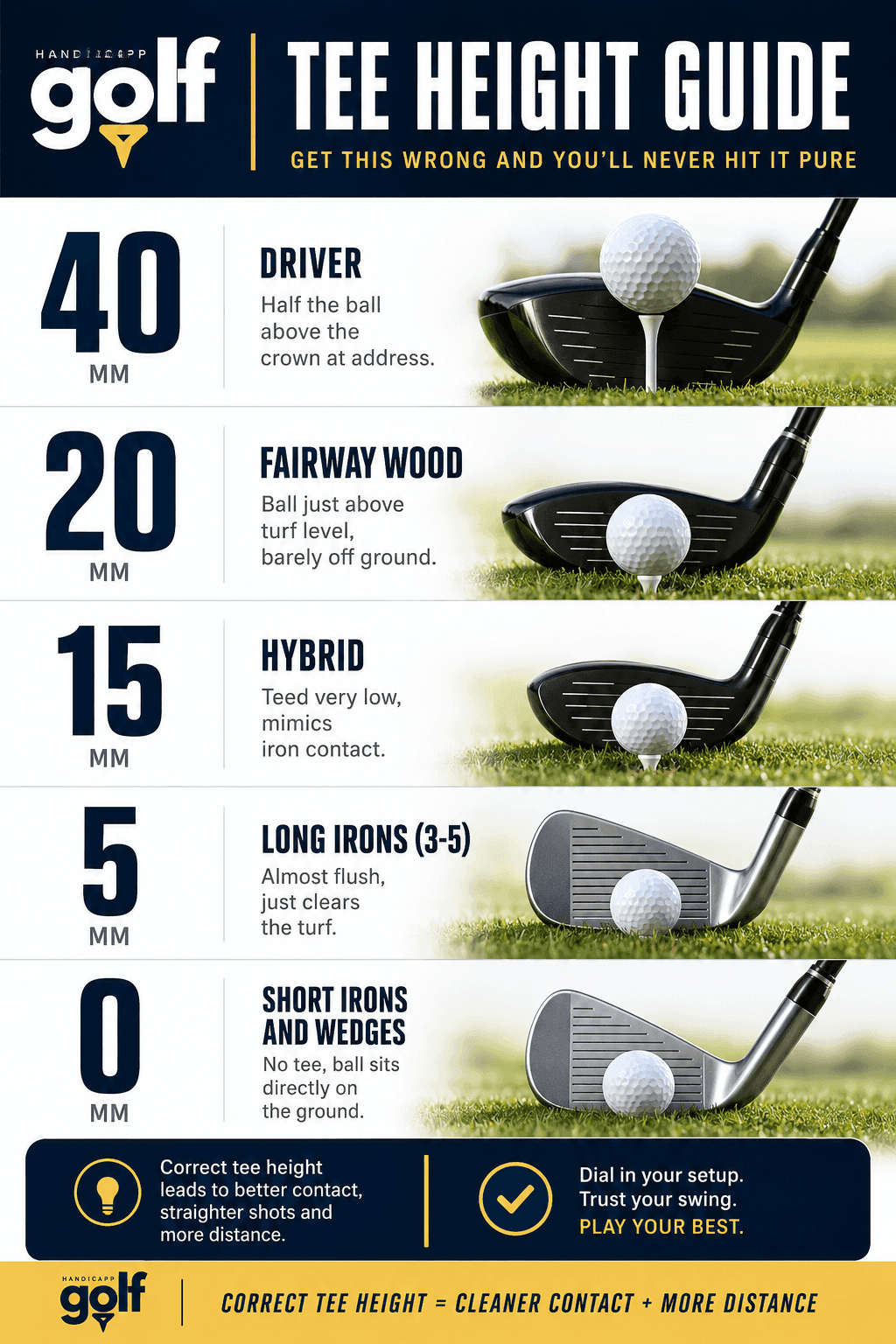
Tee height changes with the club. Driver high, about 40mm with half the ball above the crown, fairway wood around 20mm, hybrid around 15mm, long irons about 5mm just off the turf, and short irons and wedges flat on the ground. Match the height to the club and you strike it cleaner and carry it further.
Tee height is one of those tiny details that decides more than it should. It sets where the clubhead meets the ball on its arc, and getting it wrong is behind a surprising number of sky-marked pop-ups, thin strikes and yards left in the bag. It is also about the easiest fix in golf: no swing change, just a tee pushed a little deeper or left a little prouder. Here is the right height for every club you might tee up.
Tee height by club
Millimetres are a guide, not a science, and tees themselves vary. The principle is what matters: the longer the club and the more you want to catch the ball on the up, the higher you tee it.
| Club | Tee height | How it looks |
|---|---|---|
| Driver | 40mm | Half the ball above the crown at address. |
| Fairway wood | 20mm | Ball just above turf level, barely off the ground. |
| Hybrid | 15mm | Teed very low, mimics iron contact. |
| Long irons (3 to 5) | 5mm | Almost flush, just clears the turf. |
| Short irons and wedges | 0mm | No tee, ball sits directly on the ground. |
Driver: half the ball above the crown
The classic checkpoint still holds. Tee the ball so that when you sole the driver behind it, roughly half the ball peeks above the top edge of the clubface. That height, around 40mm of tee, lets you hit up on the ball and launch it high with low spin, which is the recipe for carry. Tee it too low and you tend to hit down on it and lose distance, too high and you sky it. This works hand in hand with playing the ball forward, covered in the ball position guide.
Fairway woods and hybrids: keep it low
These clubs are built to be swept off the turf, so they want very little tee. A fairway wood sits best just above ground level, barely off the grass, and a hybrid lower still so the strike mimics an iron. A high tee here works against the club and often produces a weak, thin shot. The reason ties back to the low point of the swing, which sits at or near the ball for these clubs.
Small setup wins, tracked over every round
Log your golf with Golf Handicapp. Logging rounds and your handicap are free, always.
Irons on a par three: barely off the ground
When you tee an iron on a short hole, the goal is to recreate a perfect fairway lie, not to lift the ball into the air. Set a long iron just clearing the turf, around 5mm, and tee short irons and wedges effectively flat, so you strike down on the ball exactly as you would from the fairway. Teeing an iron up high tempts an upward, thin strike and takes away the control that makes these the scoring clubs.
Why a repeatable tee height helps
A consistent tee height gives you a consistent starting point, which means one less variable when your strike goes wandering. Push your tee to the same depth each time, or use a tee with a marker, and you take the guesswork out of the one part of golf you fully control before the swing even starts. Little consistencies like this add up, which is the theme of our guide on how to lower your golf handicap, and you can watch the effect on your index with the WHS handicap calculator.
Common questions
How high should I tee the ball for a driver?+
High enough that about half the ball sits above the crown of the driver at address, which is roughly 40mm of tee showing. That lets you catch the ball on the upswing, which is what launches it high with low spin for the most carry.
Should I use a tee for irons?+
On a par three you can, but only just. Tee a short iron or wedge so the ball is barely off the ground, near flush, so you can strike it almost exactly as you would off the turf. Teeing an iron up high encourages a thin, upward strike.
How high should a fairway wood or hybrid be teed?+
Low. A fairway wood wants the ball just above turf level, barely off the ground, and a hybrid lower still so it mimics an iron strike. These clubs are designed to be swept off the ground, so a low tee keeps the contact clean.
Does tee height really matter?+
Yes. Tee height changes where the club meets the ball on its arc, which affects launch, spin, contact and distance. Getting it wrong is a quiet cause of pop-ups, thin strikes and lost yardage, and it is one of the easiest things in golf to fix.
Keep reading

About the author
Claudia Laurent · Golf writer, Golf Handicapp
Claudia writes about the World Handicap System, golf scoring and getting more from every round for Golf Handicapp. She is a mid-handicap golfer who logs every card, the good ones and the ones she would rather forget.
Last updated 4 July 2026.