
Claudia Laurent
Golf writer, Golf Handicapp · 5 July 2026
The short answer
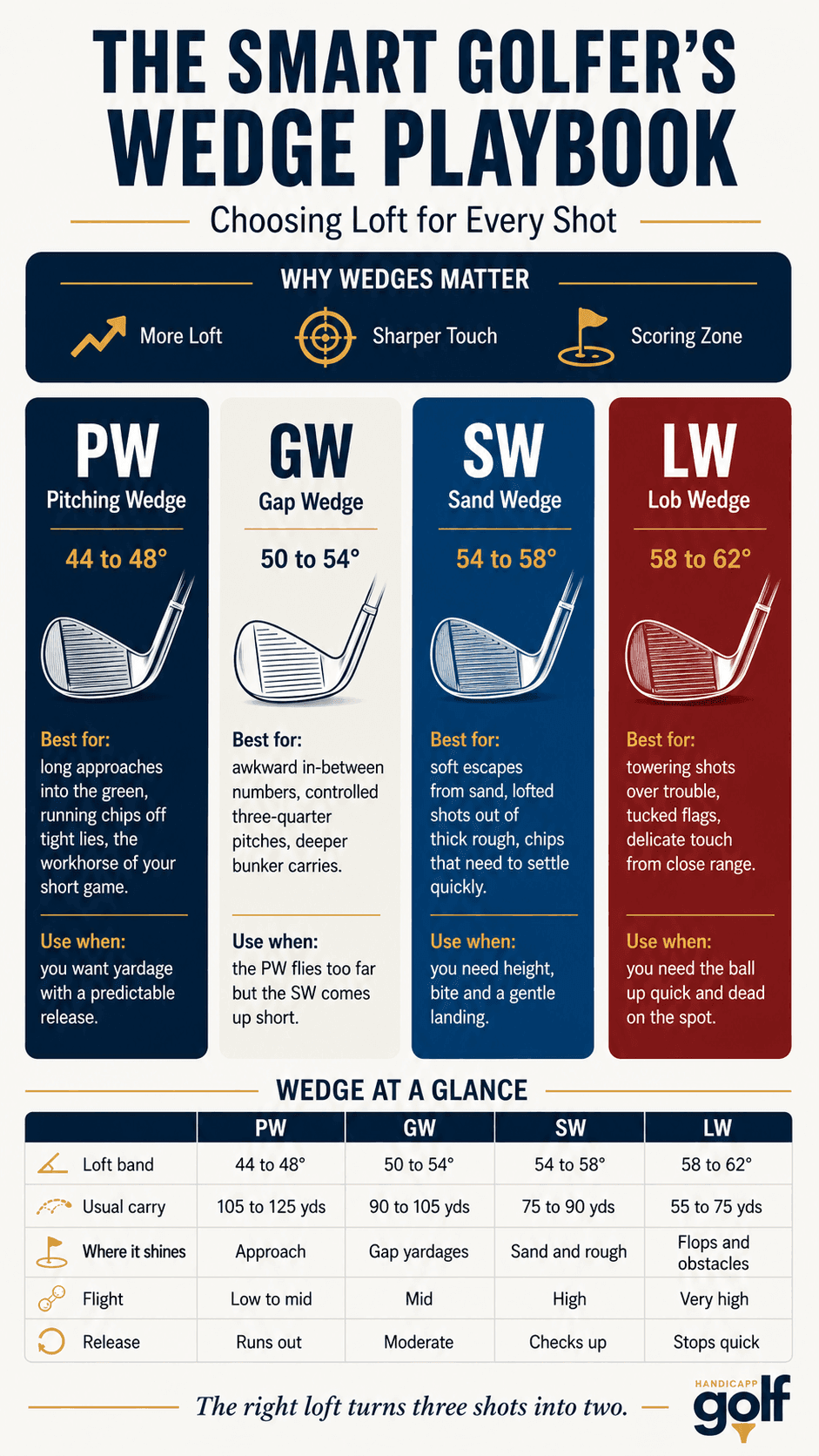
Your wedges are the scoring clubs, and the loft on each one decides the shot it is best at. Pitching wedge 44 to 48 degrees for approaches, gap wedge 50 to 54 for the in-between numbers, sand wedge 54 to 58 for sand and rough, lob wedge 58 to 62 for high, soft shots. Keep an even gap between them and you always have the right tool.
More shots are won and lost inside 125 yards than anywhere else on the course, and the wedge in your hand shapes what is even possible. Get the lofts and the gaps right and you have a club for every distance and every lie around the green. Get them wrong and you are forever manufacturing shots your equipment is fighting. Here is what each wedge is for, the loft band it lives in, and how to build a set that covers your short game without holes.
The four wedges at a glance
Carry distances are for an average male golfer and will differ for you. Use the loft bands and the gaps as your guide.
| Wedge | Loft | Usual carry | Where it shines | Flight | Release |
|---|---|---|---|---|---|
| PWPitching wedge | 44 to 48° | 105 to 125 yds | Approach | Low to mid | Runs out |
| GWGap wedge | 50 to 54° | 90 to 105 yds | Gap yardages | Mid | Moderate |
| SWSand wedge | 54 to 58° | 75 to 90 yds | Sand and rough | High | Checks up |
| LWLob wedge | 58 to 62° | 55 to 75 yds | Flops and obstacles | Very high | Stops quick |
Pitching wedge, the workhorse
At 44 to 48 degrees, the pitching wedge is the one you reach for most: full approaches into greens, running chips off tight lies, and any time you want yardage with a predictable release. It flies low to mid and runs out on landing, so it is the wedge to trust when you have a clear number and want the ball to behave.
Gap wedge, the problem solver
Modern iron sets have strong lofts, which leaves a big hole between the pitching wedge and the sand wedge. The gap wedge, 50 to 54 degrees, fills it. Reach for it on the awkward in-between numbers, the controlled three-quarter pitch, and the deeper bunker carry. If you often feel stuck between two wedges, a gap wedge is the missing piece.
Dial in your short game and watch your scores fall
Track every round with Golf Handicapp. Free, forever. No card, no subscription, no club required.
Sand wedge, the escape artist
The sand wedge, 54 to 58 degrees, is built for soft escapes: bunkers, thick rough, and chips that need to settle quickly. Its extra bounce helps the club glide rather than dig, which is exactly what you want out of sand. It flies high and checks up, so it is the choice when you need height, bite and a gentle landing.
Lob wedge, the specialist
At 58 to 62 degrees, the lob wedge produces the highest, softest shots in the bag, towering flops over trouble, tucked flags, and delicate touch from close range. It is also the hardest wedge to hit cleanly, so treat it as a specialist. If you rarely face shots that must fly high and stop dead, you may score better carrying three wedges and leaving the lob wedge at home.
Build the set around even gaps
Whatever lofts you choose, aim for a consistent step of roughly 4 to 6 degrees between wedges so that every short yardage has a home. That gapping is only useful once you know how far you actually carry each club, which is where our golf club distance charts come in. Sharper wedge play is one of the fastest routes to a lower number, as our guide on how to lower your golf handicap explains, and you can watch the effect on your index with the WHS handicap calculator. For the smart on-course thinking that gets the most from these clubs, see what shot you should play.
Common questions
What lofts should my wedges be?+
A common, well-spaced set is a pitching wedge around 44 to 48 degrees, a gap wedge around 50 to 54, a sand wedge around 54 to 58 and a lob wedge around 58 to 62. The exact numbers matter less than keeping an even gap of roughly 4 to 6 degrees between them.
Do I need a lob wedge?+
Not everyone does. A lob wedge is the specialist for high, soft shots over trouble and tucked flags, but it is the hardest wedge to hit consistently. If you rarely need to fly the ball high and stop it fast, three wedges may serve you better than four.
What is a gap wedge for?+
It fills the yardage gap between your pitching wedge and sand wedge, which on modern strong-lofted sets can be large. It shines on awkward in-between numbers, controlled three-quarter pitches and deeper bunker carries, when the pitching wedge flies too far but the sand wedge comes up short.
How far does each wedge carry?+
Very roughly, a pitching wedge carries about 105 to 125 yards, a gap wedge 90 to 105, a sand wedge 75 to 90 and a lob wedge 55 to 75, for an average male golfer. Your own carries depend on swing speed and strike, so learn them rather than assume them.
Keep reading

About the author
Claudia Laurent · Golf writer, Golf Handicapp
Claudia writes about the World Handicap System, golf scoring and getting more from every round for Golf Handicapp. She is a mid-handicap golfer who logs every card, the good ones and the ones she would rather forget.
Last updated 5 July 2026.