
Claudia Laurent
Golf writer, Golf Handicapp · 5 July 2026
The short answer
Every shot you hit is a mix of the direction it starts and the way it curves. A draw and a fade are the gentle, controllable curves you want. A hook and a slice are their wild cousins. A pull and a push fly straight but off line. Learn to read your own ball flight and you learn what your swing is doing.
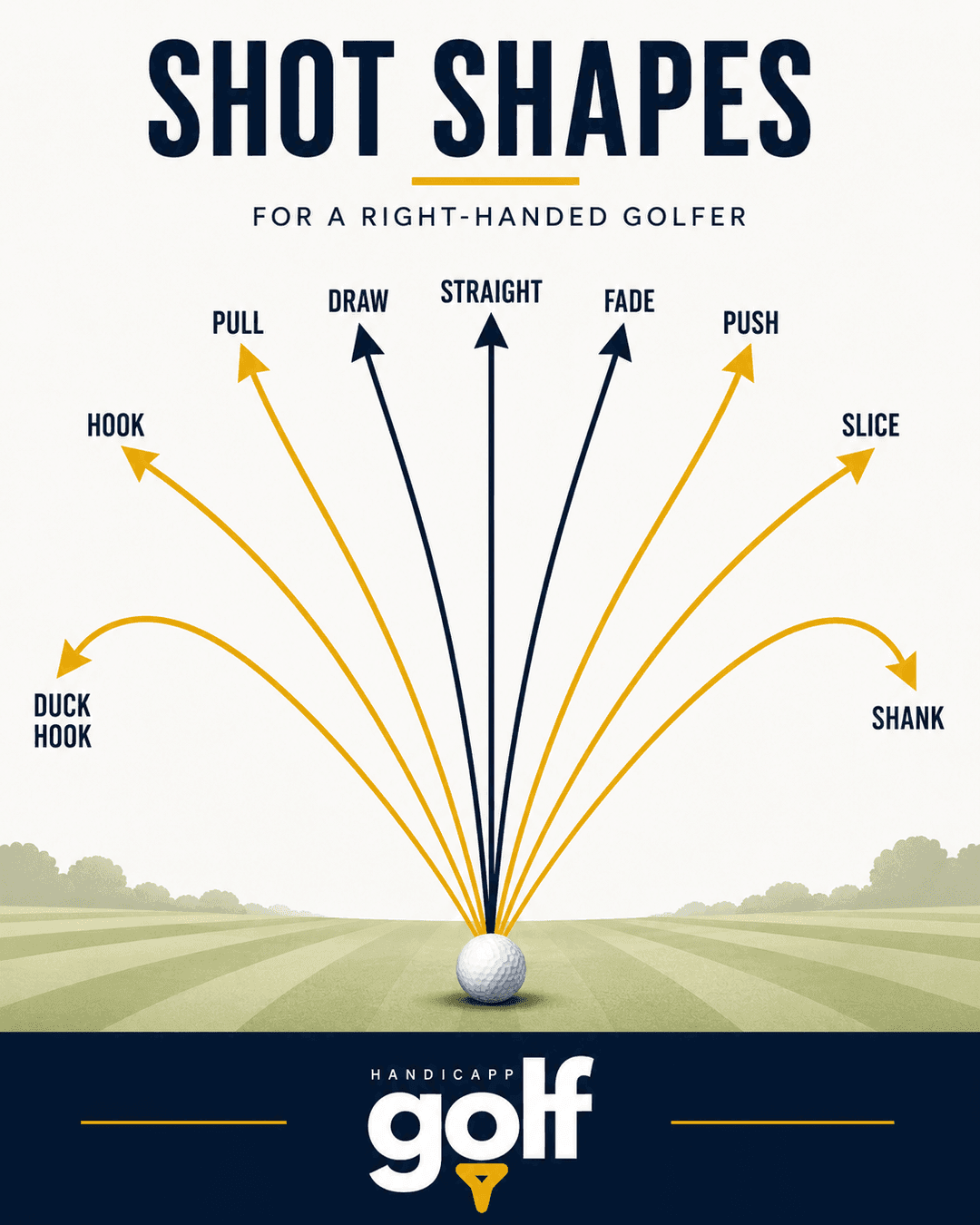
Golfers throw these words around, sometimes at each other, but the ball flight itself is a precise message about the clubface and the swing path at impact. Learn to read it and every shot becomes feedback. This guide walks through the nine shapes in the chart below, what each one looks like and what tends to cause it, all described for a right-handed golfer. Left-handers simply mirror the directions.
The nine shot shapes
Directions are for a right-handed golfer. The two things that create every shape are where the clubface points and how the swing path moves through the ball.
| Shape | Flight | What it looks like |
|---|---|---|
| Straight | On target line | Starts on line and holds it. The rarest shot of all. |
| Draw | Gentle curve left | Starts right of target and curves softly back. Controlled and playable. |
| Fade | Gentle curve right | Starts left of target and curves softly back. Lands soft, easy to control. |
| Pull | Straight left | Flies straight but left of target. Path and face both aimed left. |
| Push | Straight right | Flies straight but right of target. Path and face both aimed right. |
| Hook | Sharp curve left | Starts left and dives further left. Face closed to the path. |
| Slice | Sharp curve right | Starts straight or right and peels away right. The most common miss. |
| Duck hook | Low, hard left | A snap hook that dives left and stays low. Face very closed. |
| Shank | Off the hosel right | Squirts hard right off the hosel. A contact miss, not a curve. |
The shapes you want: straight, draw and fade
Dead straight is the rarest shot in golf, because it needs the face and path to match perfectly. That is why good players tend to favour a slight curve they can rely on. A draw starts right of target and curves gently back to it, a fade starts left and curves gently back. Both are controllable, both are repeatable, and owning one of them, then aiming to allow for it, is the single biggest step toward hitting more fairways and greens.
The straight misses: pull and push
A pull and a push do not curve much, they simply start and stay off line, a pull to the left and a push to the right. They usually mean your path and clubface are pointing the same way, just not at the target. Because there is no curve to read, they can be the most confusing misses, which is where paying attention to where the ball starts really helps.
Own your miss and post better scores
Track every round with Golf Handicapp. Free to use, with no subscription and no club membership needed.
The big curves: hook and slice
A slice, that stubborn left-to-right curve, is the most common miss in the game and comes from an open face relative to an out-to-in path. A hook is the mirror image, a hard right-to-left curve from a closed face. The duck hook is the low, snapping version that golfers dread. None of these are character flaws, they are simply the clubface and path telling on themselves, and each has a clear fix once you know which one you have.
The shank, a contact miss
The shank is the odd one out. It is not a curve at all, it is a strike off the hosel that fires the ball sharply right and low. It has its own causes, usually the club moving out toward the ball through impact, and it is best treated as a separate contact issue rather than a shot shape.
Turn ball flight into lower scores
You do not need to hit every shape on command. You need one reliable shape and a clear read on your miss, so you can aim to keep the ball in play. That is the foundation of smart course management, which we set out in what shot you should play, and it pairs with knowing your club distances so club and shape work together. Keeping the ball in play is also the quiet secret in our guide on how to lower your golf handicap, and you can track the payoff with the WHS handicap calculator.
Common questions
What is the difference between a draw and a hook?+
Both curve the same way, right to left for a right-handed golfer. A draw is a gentle, controlled curve that you can aim with. A hook is the exaggerated version, curving hard and often unplanned, usually from a clubface much more closed than the swing path.
What is the difference between a pull and a hook?+
A pull flies dead straight but starts and stays left of target, with little curve. A hook starts more on line then curves sharply left. A pull is mostly a path and face pointing left together, a hook is the face closed relative to the path.
What causes a slice?+
For a right-handed golfer, a slice is an out-to-in swing path with the clubface open to that path at impact, which puts left-to-right sidespin on the ball. It is the most common miss in golf, and the fix usually starts with squaring the face and swinging more from the inside.
Is a draw better than a fade?+
Neither is better. Plenty of the best players in the world favour a fade because it is easier to control and lands softer, while others prefer a draw for a touch more run. What matters is owning one shape you can repeat and aiming to allow for it.
Keep reading

About the author
Claudia Laurent · Golf writer, Golf Handicapp
Claudia writes about the World Handicap System, golf scoring and getting more from every round for Golf Handicapp. She is a mid-handicap golfer who logs every card, the good ones and the ones she would rather forget.
Last updated 5 July 2026.